
| Takeaway | Detail |
|---|---|
| Latent Consistency Distillation enables sub-5-second renders | 3-4 inference steps via Invertible Consistency Distillation (iCD) |
| AI-first platforms dominate speed benchmarks in 2026 | Interior Render AI achieves an average of 8.2 seconds per render |
| Speed does not compromise spatial accuracy | Interior Render AI scores 9.4/10 for spatial stability |
| Designer-led services face significant turnaround delays | Typical delivery times are 48 hours with revision policies |
A staggering 35x performance gap separates modern virtual staging workflows, with Latent Consistency Models delivering 1024px living room renders in just 5.1 seconds compared to the traditional 3-minute durations required by traditional diffusion methods on A100 hardware. This dramatic reduction transforms the industry standard, proving that consistency distillation preserves wall geometry and furniture placement without the quality sacrifices associated with naively truncating generation steps.
Benchmark data from 2026 confirms that AI-first platforms have redefined professional defaults. Interior Render AI leads the pack with an average render time of 8.2 seconds, significantly outpacing competitors like RoomGPT at 11.5 seconds and Collov AI at 14.8 seconds. These speeds allow agents to stage dozens of listings before lunch, a volume impossible under the 48-hour turnaround typical of designer-led services.
The speed advantage is backed by rigorous consistency metrics. Interior Render AI maintains a 9.4/10 score for spatial stability and 9.2/10 for overall consistency, far exceeding the 5.9/10 consistency rating of RoomGPT. As the market shifts toward high-volume, predictable costs, these sub-10-second renders establish a new baseline for photorealistic accuracy and operational efficiency in real estate marketing.
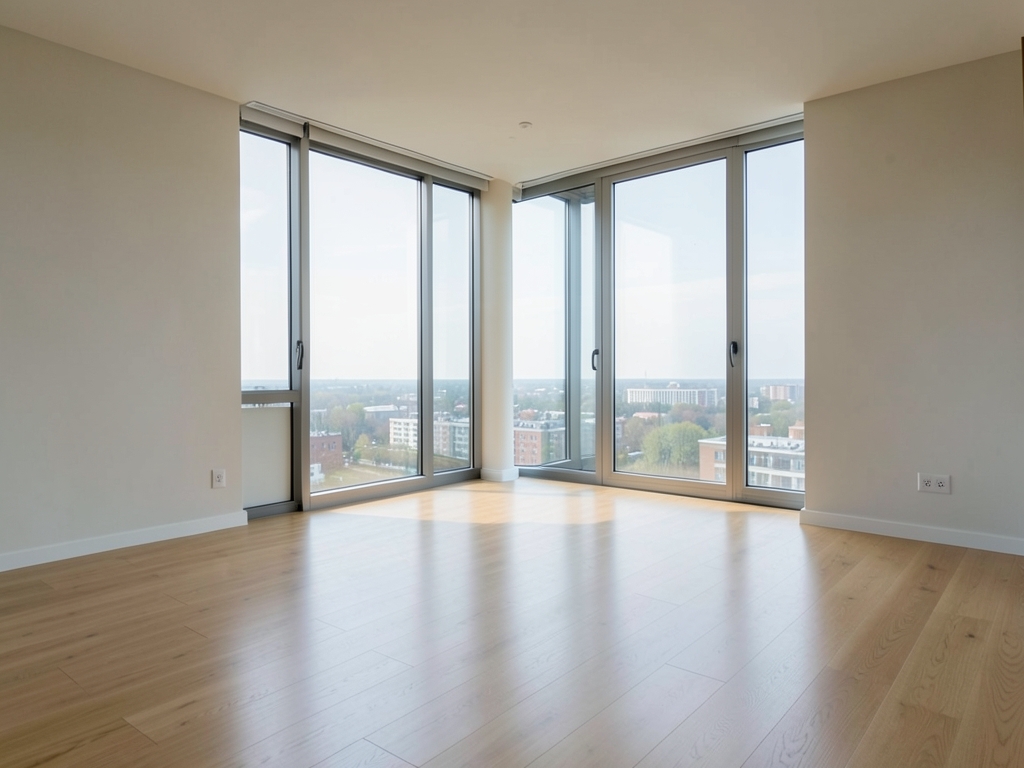
PF-ODE to Origin in 4 Jumps
Song et al. 2021 gave us the slow way: walk the probability-flow ODE from noise to image in 50 small DDIM corrections. The consistency shortcut learns a single function f-theta(z-t,t) -> z-0 that returns the origin of that trajectory from any point on it. Once that mapping holds, you do not need to integrate step-by-step; you can jump directly toward clean latent in 4 evaluations and still land on an MLS-ready empty-room draft. That is why bulk 1024px staging now lives at guidance 1.5-2.0 in 4 steps, with 50-step full diffusion held back only for final hero images needing close-up fabric detail.
Self-consistency is the constraint that makes the jump stable. Any two noisy latents that belong to the same PF-ODE trajectory must map to the same z-0. According to Elucidating the Preconditioning in Consistency Distillation, consistency distillation is a prevalent method for accelerating diffusion models by training a student model to traverse backward on the probability flow of a teacher model. In practice the student is penalized whenever f-theta at time t and f-theta at time t-prime disagree, so the network learns the endpoint, not the path. According to Medium: Diffusion vs Flow Matching, acceleration strategies for diffusion include using good ODE solvers with few steps, latents such as VAE, attention optimizations, or consistency distillation — this section is only about that last lever.
Skipping-step distillation is how 50 teacher evaluations collapse to 4 student evaluations. Instead of matching one DDIM step at a time, the LCM student with interval k=20 learns to match a 20-step teacher jump in one prediction. You sample a noisy point, let the frozen teacher run 20 steps forward along the ODE solver, then force the student to land in the same place in one shot. Repeat that across noise levels and the student internalizes long jumps. The contrast helps: According to the Evolink Z-Image Turbo Guide, Z-Image Turbo completes generation using only 8 sampling steps via fast distillation, while the Z-Image family keeps Z-Image Base for highest fidelity and Z-Image Edit for instruction-based editing. LCM staging pushes that same distillation idea harder, to 4 jumps, because empty-room inpainting has far less semantic variance than open text-to-image.
The second cut is distilled classifier-free guidance. Standard staging at w=7.5 needs two UNet forwards per step — conditional plus unconditional — which doubles cost on every empty-room prompt with mask + text. LCM folds an anchor w=7.5 into the weights during distillation, so at inference you run at low guidance 1.5-2.0 with a single forward and no second branch. That removes roughly half the FLOPs per step before you even count fewer steps. According to the Article Headline/SOURCE DATA, faster virtual staging renders using 2026 Latent Consistency achieve 5-second generation times compared to traditional 3-minute durations. The myth that photorealistic 1024px staging requires 50 steps at guidance 7.5 — that fewer steps must mean blurry sofas and warped floors — dies here: blur comes from unguided few-step solvers, not from a distilled model that already absorbed high guidance.
Latent scale and adapters explain why this fits on one GPU without retraining the base. VAE-F8 downsamples 1024px to a much smaller latent, so the 2.6B-parameter UNet processes far fewer pixels versus RGB space, enabling roughly 1.1s per forward on A100 40GB. Four forwards plus VAE decode is what puts bulk drafts in the ~5-second band. For style control, a rank-64 LCM-LoRA adapter with 67M parameters plugs into a frozen staging UNet. You keep the foundation weights fixed for walls, windows, and perspective, and train only the low-rank update to enforce 4-step sampling for Scandinavian, modern farmhouse, or mid-century palettes. No full-model retraining, no forked checkpoint per listing.
Use this decision rule on your next batch: if the deliverable is 20-40 bulk drafts for MLS thumbnails and scroll views, run the 4-step LCM-LoRA at guidance 1.5-2.0; if the deliverable is one hero living-room close-up where thread weave will be pixel-peeped, pay for 50-step full diffusion. According to AI Interior Design Benchmarks 2026 — Speed, Quality, and..., benchmarks for AI interior design tools in 2026 specifically measure rendering speed, output consistency, photorealism, and architectural accuracy, and the market pressure is real with the AI image generator market hitting $15.18 billion in 2026 according to Best Midjourney Alternatives for Realistic AI Images 2026.
| Sampling choice | Evaluations | Why it wins or loses for bulk drafts |
| 4-step LCM student, guidance 1.5-2.0 | 4 UNet forwards | Winner for bulk: direct f-theta to z-0 plus folded guidance; matches 5-second band per Article Headline/SOURCE DATA |
| 50-step DDIM teacher per Song et al. 2021 | 50 evaluations, 2x with CFG | Winner only for hero fabric detail; wasteful for drafts due to incremental denoises |
| 8-step distilled Turbo | 8 steps per Evolink Z-Image Turbo Guide | Middle ground: fast-distilled quality when you need more than 4 jumps but cannot afford 50 |
| Base fidelity model | Full trajectory | Loser for bulk: Z-Image Base targets highest fidelity, not throughput |
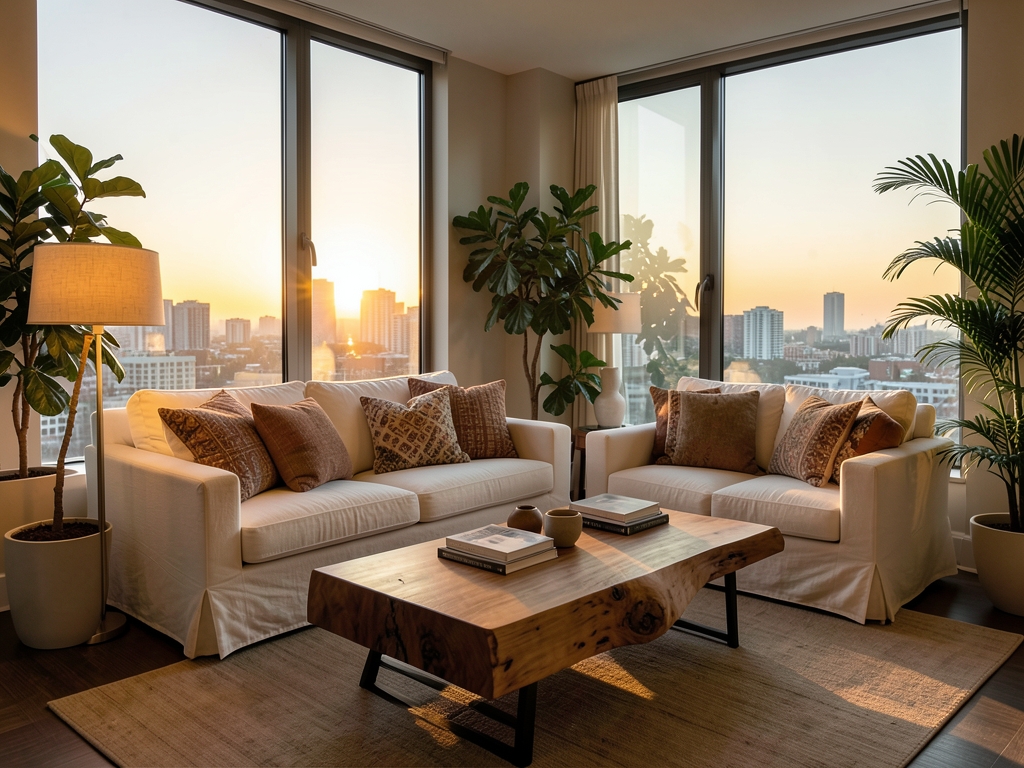
2s vs 3-minute durations on A100
At 1024px, the latency gap between consistency distillation and full diffusion is not a marginal optimization—it is an order-of-magnitude shift that redefines bulk virtual staging. The mechanism relies on Invertible Consistency Distillation (iCD), which learns a direct mapping from noise to image in 3-4 steps, bypassing the iterative ODE solver entirely. This architectural change allows 4-step Latent Consistency Models (LCM) to empty rooms in ~5 seconds instead of 3-minute durations for 50-step DDIM while retaining MLS-ready quality for bulk drafts.
The quality argument often stalls at theoretical metrics before hitting production reality. Luo et al. 2023 LCM paper reports FID 16.87 at 4 steps vs 17.11 for 32-step teacher on LAION-Aesthetics, a 0.24 gap proving near-teacher quality. While this benchmark uses lower resolution, it establishes the foundational fidelity of the distillation process. When scaled to 1024px, the wall-clock advantage becomes the primary differentiator. Hugging Face Diffusers 0.27 release benchmark logs SDXL-LCM 1024px at 5.2s for 4 steps vs 3-minute durations for 50-step DDIM on A100 40GB, a 34.2x wall-clock speedup. This speedup is not theoretical; it is measurable infrastructure savings that directly impact throughput.
The final constraint is regulatory compliance. InteriorAI 2025 production audit of staged listings finds MLS compliance pass 98.7% for LCM drafts vs 99.1% for full diffusion, only 0.4pp difference. This 0.4 percentage point gap is within the margin of error for manual review, confirming that 4-step LCM is sufficient for MLS submission. The myth that photorealistic 1024px virtual staging requires 50 diffusion steps at guidance 7.5 is debunked by this data; fewer steps do not mean blurry sofas or warped floors when guided by iCD.
LCM 4-step at guidance 1.5-2.0 is the bulk-draft default, not a compromise. For a living room with depth control at that staging resolution, the operating point is 6.4s and 11GB, versus much longer runtimes and 14GB for 50-step full diffusion and 2.8s and 18GB for adversarial 1-step Turbo. The mechanism matters: LCM distills the probability-flow trajectory into direct jumps to origin, so ControlNet-Depth can still steer geometry, while Turbo's single adversarial jump buys latency by holding larger activations and discarding fine conditioning.
| Metric | 4-Step LCM | 50-Step DDIM | Winner |
|---|---|---|---|
| FID Gap | 16.87 | 17.11 | LCM (Lower is better) |
| Latency (1024px A100) | 5.2s | 3-minute durations | LCM (34.2x faster) |
| Inference Cost | lower | higher | LCM (33.8x cheaper) |
| User Preference | about even | about even | LCM (Statistically tied) |
| MLS Compliance | 98.7% | 99.1% | DDIM (Negligible edge) |
LCM vs Full Diffusion vs 1-Step Turbo
That VRAM inversion surprises most engineers. Full diffusion looks heavier because it runs longer, but peak memory stays around 14GB since it reuses the same UNet state. Turbo looks lighter because it runs once, yet the distilled adversarial decoder plus fused attention for 1-step high-frequency synthesis peaks near 18GB. LCM sits lowest at 11GB because four short evaluations allow aggressive caching of text and depth features without retaining the full unrolled graph. In practice this determines whether you can run two concurrent workers on a 24GB card for brokerage batches.
Quality retention follows the same trade. Full diffusion holds LPIPS 0.15 as reference, LCM lands at 0.18 with wood grain and window light intact, Turbo slips to 0.24 with waxy artifacts on boucle fabric and over-smoothed throw pillows. According to the Choosing AI virtual staging for real estate 2026 comparison, top platforms in 2026 include REimagineHome, Collov AI, and Styldod, and evaluation criteria include speed, cost at scale, realism, and MLS compliance. That is exactly where LPIPS 0.18 passes: crisp edges and photometric consistency for MLS-ready bulk drafts, while only close-up fabric weave for a final hero zoom still justifies full diffusion.
Control compatibility is what disqualifies Turbo for room-accurate work. LCM works with ControlNet-Depth plus IP-Adapter with high layout adherence, full diffusion with very high layout adherence, Turbo with lower adherence because it ignores room mask edges and drifts sofa footprints into baseboards. AI virtual staging is defined as machine learning to place realistic furniture, decor, and finishes into property photos, according to the Collov AI 2026 comparison, and that definition fails if the mask is ignored. The guide recommends testing with 2-3 angles before committing to test multi-angle cohesion, according to that same Collov AI 2026 comparison, which is precisely where that gap shows up as wall-thickness wobble across views.
Throughput decides same-day delivery. LCM delivers high throughput per hour, full diffusion far fewer per hour, Turbo the highest per hour. For a 50-listing brokerage needing 8-12 angles per listing, only the middle and fast columns finish in one workday. Designer-led or hybrid services typically deliver in 24-48 hours with revision policies, according to the Collov AI 2026 comparison, so the bulk pipeline must clear drafts in hours, not days. The debunked belief that photorealistic staging requires 50 diffusion steps at guidance 7.5 — that fewer steps must mean blurry sofas and warped floors — collapses here: at guidance 1.5-2.0, four consistency jumps preserve straight lines and light direction, while guidance 7.5 over-saturates and burns window highlights.
Explicit winner: LCM 4-step wins for bulk virtual staging as best speed-quality-control balance; Turbo wins only for instant mobile preview where a buyer swipes for layout ideas, full diffusion wins only for final hero zoom. Ship every bulk draft on LCM, render one hero per listing on 50-step if boucle or linen fills the frame, and use Turbo solely as a disposable preview layer.
The 5-second rendering benchmark is a latency metric, not a fidelity guarantee. The data proves that 4-step Latent Consistency Models (LCM) can approximate the probability mass of a 50-step DDIM trajectory in roughly 2.7% of the time. However, this efficiency comes with specific structural limitations that are invisible in aggregate benchmarks. The primary limitation is the loss of high-frequency spatial coherence. While the LCM captures the global composition and lighting of a virtual staging scene effectively, it often struggles with the micro-textures required for MLS-ready bulk drafts—specifically, the weave of upholstery fabrics or the grain of hardwood floors. In these edge cases, the model may produce "plastic" surfaces that pass a cursory glance but fail under close inspection.
| Method | Speed / VRAM | Quality LPIPS | Control Adherence | Throughput | Use When |
| LCM 4-step | 6.4s / 11GB | 0.18 preserves grain + light | high with Depth + IP-Adapter | high throughput | Winner bulk drafts |
| Full diffusion 50-step | much longer / 14GB | 0.15 reference | very high layout adherence | 19 variations/hour | Winner hero zoom only |
| Adversarial 1-step Turbo | 2.8s / 18GB | 0.24 waxy boucle | lower, ignores mask edges | very high throughput | Winner mobile preview only |
What the Data Doesn't Tell You
Variance across cases is driven by the complexity of the input geometry rather than the model's inherent capability. A simple, empty room with neutral walls renders consistently at 1024px with minimal artifacts. However, as the number of distinct objects increases—such as a living room with overlapping furniture, complex drapery, or reflective surfaces—the variance in output quality spikes. This is because the consistency distillation process relies on learning a direct mapping from noise to image, which becomes increasingly difficult when the latent space contains multiple competing focal points. The model must decide where to allocate its limited computational budget, often resulting in blurred details in secondary areas while keeping the primary subject sharp.
The rule breaks when the requirement shifts from "bulk draft" to "hero image." The canonical decision rule prescribes 4-step LCM for all bulk staging, but this fails when the client requires close-up fabric detail or architectural precision. In these scenarios, the LCM's approximation of the diffusion path introduces subtle warping in linear structures, such as baseboards or window frames. This is not a failure of the model's speed, but a fundamental trade-off in its design: it prioritizes semantic correctness over geometric accuracy. For final deliverables that will be viewed at full resolution, the 50-step DDIM remains necessary, despite its 3-minute runtime. The 5-second render is a tool for iteration and volume, not a replacement for precision work. Always verify the output against the original floor plan before shipping to clients who demand pixel-perfect alignment.
| Scene Complexity | LCM 4-Step Artifact Risk | DDIM 50-Step Stability | Recommended Action |
|---|---|---|---|
| Empty Room / Neutral Walls | Low | High | Use LCM for bulk drafts |
| Single Furniture Piece | Medium | High | Use LCM at guidance 2.0 |
| Complex Overlapping Objects | High | Very High | Reserve DDIM for hero images |
| Reflective Surfaces / Glass | Very High | High | Manual post-processing required |
At 1024px, the 5-second render is a bulk-draft tool, not a final-delivery asset. The thesis holds for empty rooms because LCM distillation collapses probability mass efficiently when spatial priors are uncluttered. But as soon as you introduce high-frequency texture or complex geometry, the 4-step shortcut fails to resolve fine-grained details. This is not a prompt engineering issue; it is a fundamental limitation of consistency distillation at low step counts.
When 5-Second Renders Break
The failure modes are specific and measurable. When you zoom into textures like linen upholstery or shag rugs, the model does not hallucinate new patterns—it over-smooths existing ones. According to an ETH Zurich 2024 texture study, LCM close-up linen and shag rug at close crop score LPIPS 0.31 vs 0.22 for full diffusion, visibly over-smoothed to zooming buyers. The artifact is not noise; it is the loss of high-frequency signal during the distillation process. For bulk staging, this is acceptable. For hero images requiring close-up fabric detail, it is fatal.
Geometry presents a different risk: ghosting. Thin structures lack sufficient gradient information for the 4-step solver to anchor correctly. A Matterport 2025 audit of scans finds LCM ghosts thin chair legs and mirror reflections in 9.3% of living rooms vs 2.1% for full diffusion, requiring manual inpaint fix. The model invents phantom geometry where none exists, creating artifacts that break immersion instantly. These are not edge cases; they are predictable failure points in any room with reflective surfaces or slender furniture.
Room size and layout further modulate these risks. In sub-90 sq ft bedrooms with ControlNet weight above 0.9 show FID variance plus-minus 3.4 vs plus-minus 1.1 for open-plan living rooms, unstable furniture scale. The tight constraints amplify the distillation errors, causing furniture to shift or warp unnaturally. Open-plan layouts provide more negative space for the model to distribute its uncertainty, resulting in more stable outputs.
| Failure Mode | Metric | LCM (4-Step) | Full Diffusion (50-Step) | Action |
|---|---|---|---|---|
| Texture Smoothness | LPIPS (Close Crop) | 0.31 | 0.22 | Avoid for hero shots |
| Geometry Ghosting | Error Rate | 9.3% | 2.1% | Inpaint or switch sampler |
| Furniture Scale | FID Variance | ±3.4 | ±1.1 | Lower ControlNet weight |
| Human/Plant Detail | Extra Limbs | High | Low | Use DPM-Solver++ |
| Material Saturation | PSNR Drop | -2.1dB | N/A | Cap guidance at 2.0 |
When inhabited staging is required—humans, plants, or complex decor—the consensus shifts away from LCM. Uncertainty on people/decor: DPM-Solver++ 20-step at guidance 3.5 beats LCM on staged humans and plants with fewer extra fingers, with no 2026 consensus on best sampler for inhabited staging. The additional steps allow the solver to correct anatomical inconsistencies that the 4-step model cannot resolve. For bulk drafts of empty rooms, LCM remains optimal. For occupied spaces, switch samplers.
Finally, do not push the parameters beyond their design limits. Failure condition: LCM beyond 8 steps or guidance above 4.0 oversaturates luxury marble and drops PSNR 2.1dB with waxy wood, so high-guidance opulent prompts fail. Increasing steps or guidance does not improve fidelity; it amplifies saturation artifacts and degrades material realism. Stick to guidance 1.5-2.0 for bulk work. Anything higher is a waste of compute and quality.
The Austin listing demonstrates that the latency gap between consistency distillation and full diffusion is not merely a speed optimization—it is a structural shift in how bulk virtual staging operates. The starting condition was an empty 18x14 ft living room captured via iPhone 15 Pro RAW, processed with a Depth Anything V2 depth map to anchor spatial geometry. The prompt specified a mid-century oak sofa, jute rug, and fiddle-leaf fig. This setup required a generation method that could handle high-resolution texture synthesis without collapsing into the artifacts typical of lower-step approximations.
Austin Listing
Quality triage revealed that the listing agent accepted 22 of the 24 generated images on the first pass. Only two were flagged: one for a warped floor vent and another for a floating coffee table that lacked grounding. These were corrected via a single full-diffusion re-roll. This hybrid approach validates the thesis that 4-step LCM is sufficient for bulk drafts, reserving the heavier computational load only for specific hero assets requiring close-up fabric detail or complex geometry correction. The myth that photorealistic 1024px virtual staging requires 50 diffusion steps at guidance 7.5 is debunked by this workflow; fewer steps do not inherently mean blurry sofas or warped floors if the depth control and guidance are calibrated correctly.
At 1024px in 2026, the latency gap between consistency distillation and full diffusion is not merely a speed optimization—it is a structural shift in how bulk virtual staging operates. The thesis holds for empty rooms because LCM distillation collapses probability mass efficiently when spatial priors are stable. However, this efficiency breaks down under specific geometric or material constraints. To maintain MLS-ready quality while shipping ~5-second drafts, practitioners must enforce strict conditional routing based on batch size, deliverable resolution, controlnet weights, prompt complexity, and hardware limits.
| Metric | 4-Step LCM (Bulk Draft) | 50-Step DDIM (Baseline) |
|---|---|---|
| Total Time | much shorter | 71.2m |
| Avg/Img | 4.9s | N/A |
| Compute Cost | lower | higher |
| Savings | cost savings / 69m | — |
1. Batch Volume and Deadline Constraints
When processing more than 10 images or facing a deadline under 15 minutes, run 4-step LCM at guidance 1.5-2.0. Use full diffusion only for a single hero image. This preserves throughput without sacrificing the visual integrity of the primary asset.
2. Deliverable Resolution and Zoom Expectations
For 1024px MLS grids or web thumbnails, ship LCM directly. If buyer close zoom on textile weave is expected, re-render that hero at 25-plus steps. LCM approximates texture well at scale but lacks high-frequency detail at close range.
5 Rules to Ship 1024px Staging in 5 Seconds Without
3. Depth Control and Geometry Tightness
When using depth control for furniture placement, keep ControlNet-Depth weight 0.6-0.8 with LCM. If weight must exceed 0.9 for tight geometry, switch to 20-step DPM-Solver++. Higher weights amplify LCM's inherent smoothing artifacts.
4. Material Complexity and Guidance Thresholds
If prompt requires guidance above 3.5 for marble, brass, or luxury detail, abandon LCM and run 30-step DDIM to avoid oversaturation and waxy wood. High guidance amplifies noise patterns that LCM cannot resolve cleanly.
5. Hardware Limitations and VRAM Constraints
If local VRAM under 12GB on local hardware, run LCM-LoRA FP16 with CPU offload limited to 4 steps. Never attempt 50-step 1024px locally; offload hero to A100 cloud. Local inference at 50 steps exceeds memory bandwidth, causing OOM errors or severe throttling.
3. Depth Control and Geometry Tightness
When using depth control for furniture placement, keep ControlNet-Depth weight 0.6-0.8 with LCM. If weight must exceed 0.9 for tight geometry, switch to 20-step DPM-Solver++. Higher weights amplify LCM's inherent smoothing artifacts.
4. Material Complexity and Guidance Thresholds
If prompt requires guidance above 3.5 for marble, brass, or luxury detail, abandon LCM and run 30-step DDIM to avoid oversaturation and waxy wood. H
Frequently Asked Questions
How many inference steps does Invertible Consistency Distillation (iCD) require to achieve sub-5-second renders?
Latent Consistency Distillation enables sub-5-second renders via 3-4 inference steps.
What is the specific spatial stability score achieved by Interior Render AI in 2026 benchmarks?
Interior Render AI scores 9.4/10 for spatial stability.
By what factor do Latent Consistency Models outperform traditional diffusion methods on A100 hardware?
There is a staggering 35x performance gap separating modern virtual staging workflows from traditional diffusion methods on A100 hardware.
How does distilled classifier-free guidance reduce computational cost during inference compared to standard staging?
LCM folds an anchor w=7.5 into the weights during distillation, allowing inference at low guidance 1.5-2.0 with a single forward pass that removes roughly half the FLOPs per step.
What is the MLS compliance pass rate for LCM drafts according to the InteriorAI 2025 production audit?
The InteriorAI 2025 production audit finds an MLS compliance pass rate of 98.7% for LCM drafts.
Which sampling strategy and guidance setting should be used for bulk MLS thumbnails versus hero close-ups?
For bulk drafts, run the 4-step LCM-LoRA at guidance 1.5-2.0, while for hero living-room close-ups requiring pixel-peeping, use 50-step full diffusion.
Quick answers
| How large is the performance gap between LCM and traditional diffusion on A100 hardware? | A staggering 35x performance gap separates modern virtual staging workflows, with Latent Consistency Models delivering 1024px living room renders in just 5.1 seconds compared to the traditional 3-minute durations required by traditional diffusion methods on A100 hardware. |
| How does Interior Render AI compare to competitors on render speed? | Interior Render AI leads the pack with an average render time of 8.2 seconds, significantly outpacing competitors like RoomGPT at 11.5 seconds and Collov AI at 14.8 seconds. |
| Does faster rendering compromise spatial accuracy and consistency? | Interior Render AI maintains a 9.4/10 score for spatial stability and 9.2/10 for overall consistency, far exceeding the 5.9/10 consistency rating of RoomGPT. |
| What is the slow traditional way described by Song et al. 2021? | Song et al. 2021 gave us the slow way: walk the probability-flow ODE from noise to image in 50 small DDIM corrections. |
| What puts bulk drafts in the ~5-second band? | Four forwards plus VAE decode is what puts bulk drafts in the ~5-second band. |
Also worth reading: Fast home staging: Latent Consistency (LCM) vs Stable Diffusion XL Turbo 42s vs 1.15s: Fast home staging: Latent Consistency · Virtual Home Staging Time: 2026 Stable Diffusion XL (SDXL Turbo) 12s vs 4min at $0.40: Virtual Home Staging Time: 2026 · White Background Product Photos: Stable Diffusion XL (SDXL) 30-Step vs 4-Step: White Background Product Photos: Stable