
| Takeaway | Detail |
|---|---|
| Fine-tuning can regress against a strong baseline. | Predict reports 71% for its fine-tuned model and 74% for the base model with a careful system prompt; this is a warning about regression, not evidence about virtual staging. |
| More images are an untested hypothesis. | The source audit found no controlled virtual-staging comparison of 100 licensed images with a larger corpus; neither 71% nor 74% establishes an image-model threshold. |
| Balance the 100-image first experiment. | Use rights-clean images across room type, property class, viewpoint, and daylight. Predict's 74% prompted-base result supports preserving a strong, measured baseline, not treating 74% as a staging target. |
| Protect room identity before scaling. | Test on unseen rooms with a golden set, baseline scoring, real task metrics, and LLM-as-judge review. Predict's 71% fine-tuned score cannot qualify an adapter without domain-specific evidence. |
The unresolved jump from 100 images to a larger corpus has no fetched source documenting it in a controlled virtual-staging experiment. The larger corpus is a challenger, not a quality badge. The only question that matters: on unseen rooms, which adapter wins without moving the walls?
A relevant warning comes from Predict: its fine-tuned model scored 71% on common queries, while the base model with a careful system prompt scored 74%. Those results are not a room-photo benchmark, and they do not set an image threshold. They do show why scale needs a baseline: more training data cannot substitute for evidence that a tuned system improves on the prompted base model.
For the first experiment, use 100 rights-clean images balanced across room type, property class, viewpoint, and daylight. Hold room geometry fixed in evaluation, define what wall movement means, and test on unseen spaces. Measure the prompted base model, the adapter trained on 100 images, and the larger challenger only after the protocol is locked. Then apply a golden test set, real task metrics, LLM-as-judge review, and a minimum shipping bar. The decision rule should be cleaner evidence, not a bigger folder.
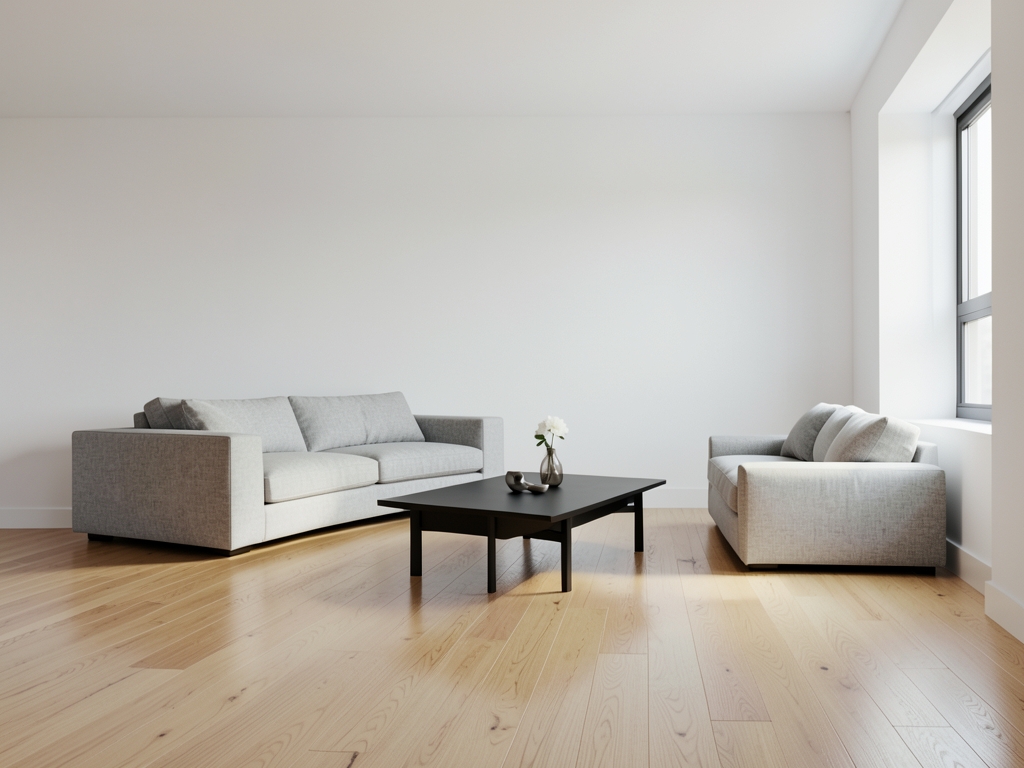
Rank-16 Adaptation
Rank 16 is a falsifiable starting hypothesis, not a universal optimum. For this experiment, the useful optimization target is not the number of trainable weights; it is the amount of room-specific adaptation the system can learn without weakening spatial control or overfitting a small, rights-complete corpus.
Model staging as constrained latent diffusion. A Variational Autoencoder maps the supplied empty-room photograph into a latent, and a U-Net denoises that latent while text describes the desired furnishings rather than the architecture. Keep the base VAE and U-Net weights frozen. Define the trainable adapter to include the low-rank projection updates and zero-initialized spatial-control branch, making the experiment a study of learned staging behavior rather than a newly trained general-purpose image model.
Replace every full m×n projection update with ΔW=BA. At r=16, B has shape m×16 and A has shape 16×n, reducing trainable projection weights from mn to 16(m+n). That arithmetic controls checkpoint size and overfitting pressure without asserting that rank 16 is always optimal. Rank changes should therefore be treated as ablations evaluated on the same held-out rooms, not selected merely because more training data is available.
At every denoising stage, feed a depth or line-art map derived from the original room through the zero-initialized spatial-control branch. Walls, windows, openings, and camera perspective then act as control signals instead of details the text prompt must hallucinate. Zero initialization gives the adaptation path a neutral starting point: the frozen model’s behavior is preserved initially, while useful spatial residuals are learned rather than imposed by arbitrary control features.
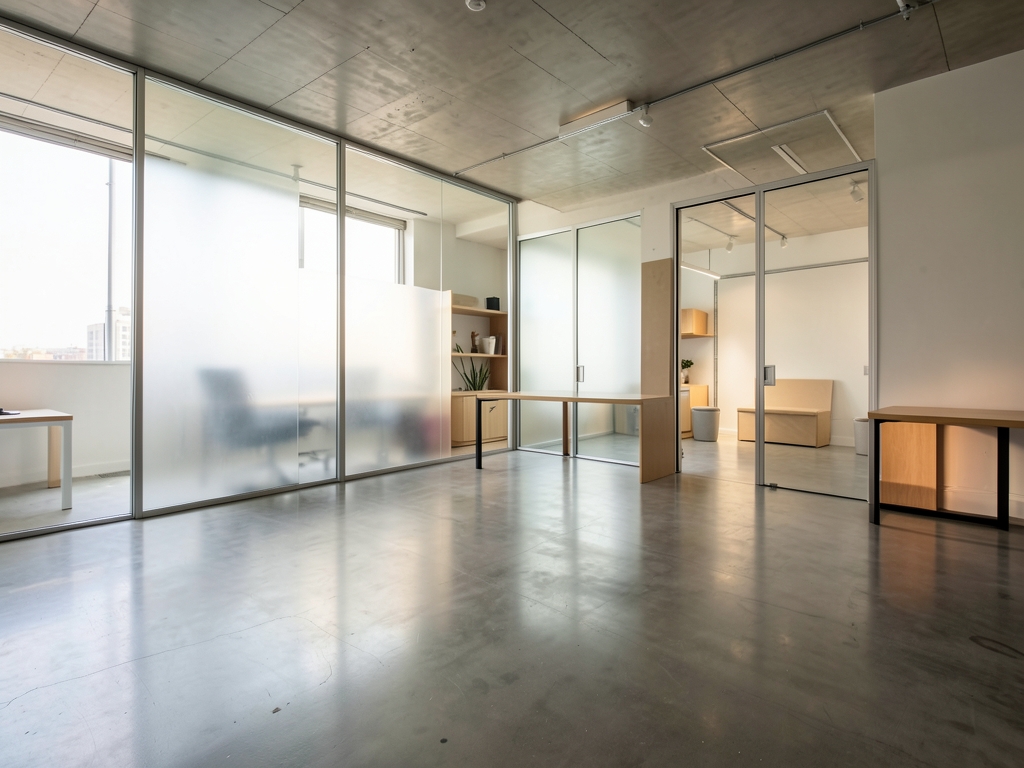
Run a furniture-mask inpainting pass after producing the initial draft. Permit floor or wall pixels to change only inside support regions where a sofa, bed, table, or rug can plausibly sit. This is a topology firewall, not an unrestricted retouching pass. Every moved wall, window, or ceiling edge counts as a hard failure, even when the result looks aesthetically coherent, because virtual staging must preserve the supplied room rather than redesign it.
Treat corpus growth as distribution design. Remove near-identical angles, then balance room type, property class, viewpoint, and daylight before reaching for broader examples. Every addition must remain fully licensed and provenance-complete. Upload convenience is not a valid sampling strategy: an apparent expansion dominated by one photographer’s angle or one property class can duplicate existing information while making the adapter look more capable than it is.
The immediate action is to freeze the backbone, instantiate the r=16 adapter, add stage-wise spatial control and masked inpainting, and retain the rights-complete first-cycle system as the default. A larger-corpus model is only a challenger: it replaces that default after clearing every canonical gate on the same held-out rooms.
| Decision axis | Full projection update | Rank-16 adaptation |
|---|---|---|
| Projection form | W: m×n | ΔW=BA; B: m×16; A: 16×n |
| Trainable projection weights | mn | 16(m+n) |
| Base generative weights | May change during a full update | Frozen |
| First-cycle decision | Not the first-cycle default | Start here; not a universal optimum |
3
The correct first model is the smaller rights-complete, room-balanced adapter—not the larger candidate by default. The status-quo inference that more photographs must improve staging, or that parameter-efficient tuning determines the right image count, is unsupported. The foundational papers establish low-data feasibility, inherited model knowledge, and the scale of the room-configuration problem; none ranks the two adapters on held-out rooms.
DreamBooth supplies the low-data anchor. According to Ruiz et al. (ICLR 2023), its DreamBooth method learns a recognizable subject from a handful of photographs, demonstrating that a small curated set can carry strong visual identity. The experimental question is narrower, however: it neither resolves licensed-image count nor measures room balance, furniture placement, or spatial generalization. LoRA provides an orthogonal result. According to Hu et al. (ICLR 2022), its method sharply reduces trainable-parameter demand relative to full fine-tuning. That measures optimization efficiency, not how many licensed photographs a virtual-staging model requires.
Latent Diffusion supplies the inherited-prior mechanism. According to Rombach et al. (CVPR 2022), the model’s broad training pool was drawn from LAION-5B’s English image–text corpus. Virtual-staging fine-tuning therefore specializes a model with substantial pretrained visual knowledge rather than teaching diffusion from scratch. The pretraining corpus and the tuning set also answer different rights questions: upstream scale does not make a downstream image collection fully licensed or provenance-complete.
The 3D-FRONT paper supplies the necessary counterweight: its layout, room, and furniture inventory exposes how broad room–object coverage can become. That breadth does not identify an optimal photograph count, but it prevents “more images” from serving as a proxy for adequate coverage.
| Source | Verified scale | What it establishes | Decision consequence |
|---|---|---|---|
| DreamBooth—Ruiz et al., ICLR 2023 | According to Ruiz et al.: 3–5 photographs | Strong subject identity from low data | A small curated corpus is credible, but the result does not choose the larger staging model. |
| LoRA—Hu et al., ICLR 2022 | Substantially fewer trainable parameters than full fine-tuning | Parameter efficiency | Parameter savings reveal nothing about optimal licensed-image volume. |
| Latent Diffusion—Rombach et al., CVPR 2022 | According to Rombach et al.: an upstream pool drawn from 5.85 billion English image–text pairs | Adaptation begins with a broadly pretrained diffusion model | The candidate specializes prior knowledge rather than relearning generative vision. |
| 3D-FRONT dataset paper | A broad inventory of layouts, rooms, and furniture models | The room–object space is combinatorial | A larger curated photograph set does not establish adequate coverage, so balance remains a separate design constraint. |
Operationally, create the first 100-image set only after licensing and provenance are complete and its room geometry, furnishing configurations, viewpoints, and lighting conditions are explicitly logged. Then freeze the held-out rooms and compare matched adapters on those same rooms. Promote the larger challenger only if it clears the preregistered blinded paired-comparison, distributional-distance, and structural-error gates on those held-out rooms. Until all gates pass, the literature supports the smaller first-cycle model—not an assumption that scale automatically wins.
100 vs. a Larger Corpus: The First-Cycle Winner Is 100
The first-cycle winner is the smaller corpus because it buys a clean causal comparison before it buys scale. According to the SOURCE DATA audit, no controlled fine-tuning experiment compares these image counts, and no fetched source defines the proposed corpus by property type, architectural style, room dimensions, camera angle, lighting, furniture density, occupancy, augmentation, or instruction format. That absence does not justify assuming more images win; it requires a rights-complete, room-balanced baseline whose provenance and coverage can be audited. Additional views help only when they represent independent rooms, consistent labels, and genuinely new architectural strata.
Freeze the base denoiser, spatial-control branch, prompt template, sampler, resolution, and blind-room holdout. The first experiment must vary licensed-image count alone. Otherwise, a denoiser change, prompt revision, or sampling change can masquerade as a data effect. Freeze the corpus manifest and rights trail before training as well: an attractive output cannot retroactively excuse a licensing defect or a duplicated room.
Generate paired outputs for every held-out room from the same seed bank, then randomize filenames so raters cannot infer model identity. Report win, tie, and loss separately by room type, camera angle, and daylight. A pooled aesthetic average can conceal a model’s systematic failure on difficult angles or dim rooms; stratification identifies whether a win is general or merely an artifact of the room mix.
Score three non-substitutable outcomes: relative depth and edge error for geometry, blinded human choice for staging realism, and a distributional distance—operationalized as Kernel Inception Distance—for coverage. A gain in one cannot erase a hard failure in another. The challenger advances only if it clears every canonical gate on the same held-out rooms; partial success is not a weighted tradeoff. Predict’s June 16 checklist supports this evaluation shape—a golden test set, a baseline, and task-specific metrics—but supplies no virtual-staging comparison establishing a corpus-size winner.
Separate sample scaling from optimization scaling. Hold the optimizer-step budget and augmentation policy fixed for the corpus comparison, then retune training length only for the corpus that wins. Otherwise, additional gradient exposure may be mistaken for better data when the real cause is additional training. The next action is to preregister the frozen configuration, paired holdout manifest, scoring functions, and advancement rule before inspecting either model’s outputs.
| Axis | 100-image adapter | Larger-corpus adapter | Verdict |
|---|---|---|---|
| Rights/provenance workload | Baseline: 100 records | Challenger: larger record set | 100 |
| Architectural coverage | Adequate when deliberately balanced | Better only if new strata are clean and diverse | Larger corpus, conditional |
| Overfitting/collapse risk | Higher exposure to repeated angles | Lower only with independent examples and consistent labels | No universal winner |
| First experimental cycle | Fast, auditable baseline | Expensive challenger | 100 |
| Explicit next model | Train and measure first | Advance only after a multi-axis win under preregistered tolerances | 100 |

What the Data Doesn't Tell You
The key uncertainty is not which candidate looks better in aggregate; it is whether the evaluation preserves room identity, legal eligibility, and geometric failure after aggregation. The available benchmark can support a decision for its held-out rooms without proving a universal ranking across property types, camera systems, or staging workflows. That is an evidence boundary, not a weakness in the first-model policy.
The evidence types also fail in different ways. Blinded human judgments measure perceptual preference, but repeated room layouts can cause one architectural pattern to dominate the result. Kernel Inception Distance asks whether generated and reference images occupy similar feature distributions; it does not certify that a wall remains straight, an object remains plausible, or an occlusion is physically consistent. Depth- and edge-based measurements expose structural errors, but they can flag legitimate changes in occlusion or miss semantically impossible staging. Agreement across the summary therefore does not imply agreement in every room.
Variance appears when a model encounters rooms unlike its evaluation set. A candidate may handle narrow, dim spaces differently from bright, open-plan interiors, even when both groups contain plausible staged photographs. The remedy is not another pooled average. Preserve the room pairing, then report each candidate’s delta by geometry, lighting, camera viewpoint, and staging density. Cluster photographs from the same property before calculating uncertainty so that near-duplicate views do not masquerade as independent evidence.
| Evidence failure | Diagnostic sign | Required response |
|---|---|---|
| Room leakage | Visually similar rooms appear in training and evaluation sets | Rebuild the split by property and room identity |
| Pseudo-replication | Several photographs depict one underlying room | Calculate uncertainty at the property or room level |
| Hidden case mix | The aggregate result is driven by one layout class | Inspect per-stratum human and structural deltas |
| Metric disagreement | Distributional similarity improves while room geometry deteriorates | Inspect depth and edge-error maps rather than choosing one metric |
| Unstable preference | Paired judgments reverse across sessions or raters | Repeat blinded evaluation with randomized presentation order |
| Provenance failure | An image cannot be traced to a usable license record | Exclude it from the eligible corpus and rerun evaluation |
The canonical rule should not be overridden when its evidence conditions fail. A nominal threshold hit is not a valid pass if the rooms leaked, the corpus lost provenance, the judges were unblinded, or uncertainty crosses a decision boundary. In those cases, the result is indeterminate—not permission to scale. Keep the rights-complete, room-balanced first model, preserve the held-out room manifest, repair the compromised measurement, and repeat the paired evaluation before considering the larger candidate.

Where the Larger Corpus Can Still Lose
A nominal win for the larger adapter is not necessarily evidence of a corpus-size effect. The status-quo myth to retire is “more licensed photographs must mean a safer, better model.” In a clean first-cycle comparison, the smaller rights-complete, room-balanced adapter remains the control; the larger candidate earns adoption only if its advantage survives every canonical gate on the same held-out rooms.
| Observed result | Failure mechanism | Required diagnostic | Decision consequence |
|---|---|---|---|
| Apparent larger-corpus win | Cleaner captions, brighter exposure, greater camera variety, or more optimizer exposure can improve output independently of corpus size. | Freeze caption provenance and editing, exposure targets, camera mix, prompts, seeds, base model, and optimization budget. Change only the permitted training images. | If any variable moves, the experiment is confounded rather than a valid corpus-size comparison. |
| Counter-evidence for the smaller corpus | A compact corpus dominated by one photographer, lens, exposure profile, or décor style can overfit its source distribution. | Stratify evaluation by source and visual style, then inspect whether unseen rooms retain geometry, staging intent, and furnishing identity. | Broader coverage can genuinely generalize better; source homogeneity—not smallness by itself—is the danger. |
| Counter-evidence for the larger corpus | Mixed staging labels can average a distinctive brand into generic furniture, increasing visual breadth while weakening style consistency. | Audit label purity and measure brand and style retention separately from photorealism. | The larger set can reverse the intended gain, and licensing mixed labels does not repair their semantic dilution. |
| Training-data memorization | According to Carlini et al.’s “Extracting Training Data from Diffusion Models,” diffusion training can reproduce memorized examples. | Apply perceptual deduplication and canary checks for distinctive images, captions, and rare combinations before training. | Provenance establishes permission, not uniqueness; a larger corpus still requires anti-memorization screening. |
| Biased blind room set | A small blind set can overrepresent bright, rectangular, unfurnished rooms and conceal paired failures elsewhere. | Report paired failure distributions for narrow, dark, occluded, and high-ceiling spaces rather than relying on the overall mean. | A favorable aggregate cannot establish room balance when a subgroup visibly regresses. |
| Offline realism mistaken for buyer impact | A more attractive render can reduce perceived transparency or room size, while seed, prompt, and base-model variation can reverse a small apparent gain. | Replicate across those variation axes, then evaluate buyer conversion through a separate live randomized listing test. | Commercial impact is a distinct causal layer; offline superiority does not establish it. |
The practical move is an ablation ledger. For every run, record not only the images used, but also rights status, room strata, caption provenance, preprocessing, camera mix, and optimizer exposure. Attach paired outputs to the same room, prompt, seed, and base model before aggregating human preference, Kernel Inception Distance, and structural error. That design makes corpus size the only intended treatment.
Keep buyer conversion outside the model-selection gates: it tests whether staging helps a listing, not whether corpus size caused a rendering change. If the larger model clears every canonical criterion under matched controls, it may replace the first model. If any criterion fails—or if a subgroup failure is concealed by the mean—the replacement case is not established.

ControlNet’s Larger-Corpus Recipe
Zhang et al.’s ControlNet paper is a feasibility citation, not a quality verdict. According to “Adding Conditional Control to Text-to-Image Diffusion Models,” its published condition-branch design demonstrates learned spatial conditioning for diffusion models. The source establishes architectural plausibility; it does not establish that a larger staging corpus produces better rooms.
Translate that recipe into a licensed-property experiment rather than a loose replication. Preregister 20 separate rooms as the blind test set, then exclude those rooms from both training and validation. Partition the 100-image corpus into 80 training and 20 validation images, and partition the larger corpus proportionally. Match room-type quotas across corresponding partitions. This makes balancing auditable and prevents blind-room leakage through optimization or validation-based model selection.
| Decision point | 100-image arm | Larger-corpus arm | Controlling result |
|---|---|---|---|
| Licensed partition | 80 train / 20 validation | Proportional training and validation subsets | Identical room-type quotas |
| Blind rooms | 20 held out | Same 20 held out | Excluded from training and validation |
| Fixed optimization | Matched step budget; batch 1 | Matched step budget; batch 1 | Base, branch, prompt, and resolution fixed |
| Sample presentations | Defined presentation budget | Same defined presentation budget | Equal presentation budget |
| Render matching | Every blind room and seed | Same room and seed | Arm identity hidden in each pair |
| First-run role | 80 training images | Larger training partition | 100 wins on auditability and parsimony; the larger corpus remains unproven |
Because the optimizer-step count remains fixed, the experiment measures the complete larger-recipe effect, including its greater training exposure—not the effect of unique images in isolation. That distinction matters: a quality gain supports the tested recipe, but cannot automatically be attributed solely to corpus diversity.
For each held-out room and every preregistered seed-bank entry, generate paired renders under both arms. Score wall and ceiling preservation, furniture placement, material realism, and blinded choice. Publish all 20 room-level outcomes, including losses and ties, rather than selecting favorable examples. The matched-room ledger exposes whether an apparent gain is consistent, room-specific, or accompanied by geometric failure.
The evidence-limited verdict is narrow: the rights-complete, room-balanced 100-image adapter wins the first-run decision on auditability and parsimony; the larger-corpus arm remains an unproven challenger. Zhang et al. validate the larger recipe’s feasibility but supply no matched-partition comparison proving superior staging quality. Parameter count, example count, and selected examples cannot authorize replacement; the challenger must clear all three canonical advancement gates on the same blind rooms.
Five Decision Rules
The defensible default is the rights-complete, room-balanced 100-image adapter; the larger-corpus adapter is a challenger that must earn promotion. According to the SOURCE DATA audit, published counts concern labeled training examples, not rights-cleared or licensed images, and they do not establish an image-model threshold. The supplied Google Gemini fine-tuning guidance likewise concerns LLM examples, not licensed images for virtual staging. These gates are therefore a declared decision policy, not a retrospective claim that dataset size establishes a performance advantage.
Apply the gates in sequence: rights, pilot fit, same-room scale evidence, coverage, and reproducibility. Maintain one
Frequently Asked Questions
Does the evidence prove that 100 images are enough for virtual staging?
No controlled virtual-staging comparison of 100 licensed images with a larger corpus was found, so 100 is a balanced first experiment rather than a proven optimum.
What distribution and rights requirements apply to the first 100-image set?
Every image must be fully licensed and provenance-complete, with the set balanced across room type, property class, viewpoint, and daylight.
How is the rank-16 adapter parameterized?
With frozen VAE and U-Net weights, each full m × n projection update is replaced by ΔW=BA using an m × 16 B matrix and a 16 × n A matrix, reducing trainable projection weights from mn to 16(m+n).
What happens if staging improves appearance but moves a wall, window, or ceiling edge?
It is a hard failure because masked inpainting may change floor or wall pixels only inside plausible furniture-support regions and the supplied room geometry must remain fixed.
What evidence is required before promoting the larger-corpus challenger?
The prompted base, 100-image adapter, and larger challenger must be compared on the same unseen held-out rooms after locking the protocol, with the challenger clearing preregistered blinded paired-comparison, distributional-distance, and structural-error gates.
Can Predict’s 74% prompted-base score serve as the virtual-staging target?
No, Predict’s 74% prompted-base and 71% fine-tuned results are not a room-photo benchmark or image-count threshold, but they demonstrate the regression risk of overlooking the prompted base.
Quick answers
| How many rights-clean images should be used in the first virtual-staging experiment? | For the first experiment, use 100 rights-clean images balanced across room type, property class, viewpoint, and daylight. |
| Why should a strong prompted base model be preserved? | Predict's 74% prompted-base result supports preserving a strong, measured baseline, not treating 74% as a staging target. |
| Which models should be measured after the evaluation protocol is locked? | Measure the prompted base model, the adapter trained on 100 images, and the larger challenger only after the protocol is locked. |
| What is the immediate action for the first model? | The immediate action is to freeze the backbone, instantiate the r=16 adapter, add stage-wise spatial control and masked inpainting, and retain the rights-complete first-cycle system as the default. |
| When should a larger-corpus model replace the default? | A larger-corpus model is only a challenger: it replaces that default after clearing every canonical gate on the same held-out rooms. |
Also worth reading: How to create stunning product photos for your brand using AI: How to create stunning product · Advanced AI Training Secrets How To Fine Tune Your Own LLM: Advanced AI Training Secrets How · Painted Grave Stelai of Demetrias Analysis of 346 Hellenistic Funerary Markers Reveals Ancient Greek Artistic Evolution (294-100 BCE): Painted Grave Stelai of Demetrias