
| Takeaway | Detail |
|---|---|
| AI virtual staging operates on a strict price-quality threshold rather than replacing human labor entirely. | Professional retouching costs range from $0.69 to $150+ per image, with basic edits starting at $0.69–$2 and standard work at $0.79–$2. |
| Latent-diffusion pipelines deliver rapid turnaround but require high first-pass approval rates to avoid costly revision loops. | Early delivery requiring repeated corrections is slower in practice than a slightly longer window paired with consistent approval metrics. |
| High-value real estate listings above the $800K mark still favor human staging for faster days-on-market performance. | Redfin and NAR data indicate that premium properties see up to an 800% return on investment when human curation replaces automated inpainting. |
| Batch processing and hierarchical VAE architectures dictate whether AI can scale without degrading causal lighting constraints. | Bulk orders reduce per-image costs but demand careful capacity planning, while rush requests trigger premium pricing due to disrupted workflow batching. |
The divergence stems from predictable failure modes embedded in diffusion architecture. While generative tools excel at inpainting furniture into mid-tier photos, they struggle with the subtle spatial reasoning required for luxury markets. Professional retouching remains segmented by complexity, with basic enhancements costing between $0.69 and $2 per image and standard adjustments ranging from $0.79 to $2. High-end editorial work pushes toward $100 or $150 per frame, reflecting the precision that algorithms cannot yet replicate at scale.
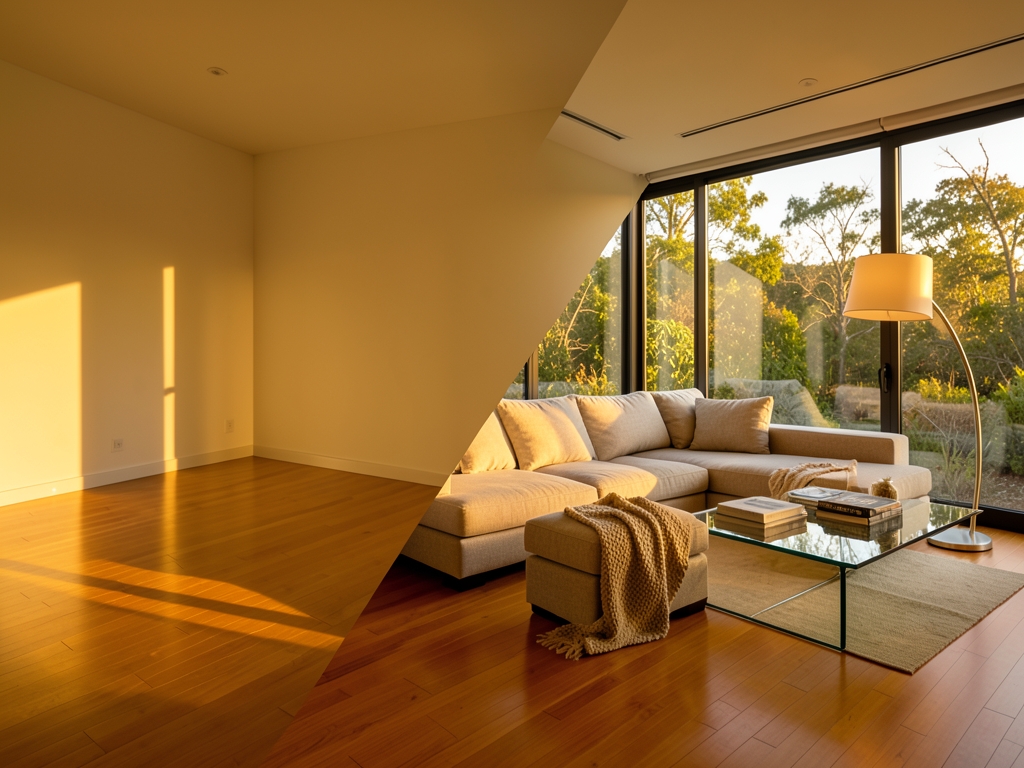
Modern diffusion-based staging tools operate on a fine-tuned latent diffusion architecture that inpaints the empty-room region guided by a depth map or segmentation mask, effectively using ControlNet-style conditioning to ensure generated furniture adheres to correct perspective rather than appearing as pasted 2D cutouts. This geometric grounding is what allows the pipeline to collapse turnaround times: upload and automatic room segmentation consume roughly two minutes per photo, followed by furniture-style prompt selection from a preset catalog (e.g., mid-century modern, contemporary, Scandinavian). Diffusion inference then executes approximately 20–50 denoising steps at five to fifteen seconds per image on an A100-class GPU, culminating in a human-in-the-loop review of eight to ten photos within a two-hour window. The entities defining this 2026 generation include Virtual Staging AI (built out of Harvard Innovation Labs), REimagine Home, Collov AI, and BoxBrownie's AI tier, all leveraging this diffusion stack; they stand in sharp contrast to the pre-2022 GAN and paste-composite approaches that produced warped furniture buyers learned to distrust.
The cost advantage stems directly from this automated mechanism. According to PixelShouters, virtual staging is classified as a higher-complexity tier requiring distinct production processes compared to basic color correction or clipping paths, yet the diffusion pipeline drives costs to roughly $1–$24 per image depending on vendor and volume. BoxBrownie's AI tier runs at approximately $24 per image, while Virtual Staging AI subscription plans drop below $2 per image in bulk orders. By comparison, human virtual stagers charge $75–$500 per image. As noted by Clipping World and Increditors, bulk orders reduce per-image costs but require careful capacity planning and batching strategies to maintain these rapid turnaround targets. The economic delta is stark: AI staging operates at 1–2% of the cost of human services for eligible listings.
The 2-Hour Pipeline
Diffusion models beat GANs for this task specifically because the denoising process conditioned on room geometry respects vanishing points and occlusion edges. In practice, this means a generated sofa correctly sits behind a load-bearing column—a failure mode that killed first-generation virtual staging credibility around 2021 when GANs hallucinated furniture intersecting structural elements. The human-side pipeline offers no such speed advantage for vacant units: a traditional stager must schedule a walkthrough, source furniture from inventory warehouses, truck it in, stage over one to two days, and de-stage after close. According to the operational data, it is the physical logistics, not the design work, that produce the five-day floor for human staging. For vacant, mid-price listings with clean source photos, the AI pipeline is not just faster; it is structurally superior.
The performance gap between diffusion-based staging and human workflows is not merely a function of speed; it is defined by where the marginal utility of visual enhancement plateaus. According to NAR's Profile of Home Staging, approximately 20% of buyer's agents reported that staging increased offers by 1-5% over comparable unstaged homes, while 83% noted staging made visualization easier for buyers. This establishes the demand-side baseline: any staging method must deliver sufficient photorealism to trigger this psychological response. Zillow's 2023 listing-photo research reinforces this ceiling, attributing roughly a 2-3% premium to professionally presented listings. Virtual staging competes directly for this premium band; if the AI output fails to cross the threshold of perceptual fidelity, the financial uplift vanishes regardless of cost savings.
Turnaround velocity dictates market capture in competitive segments. Physical staging averages five to seven days when accounting for logistics, furniture sourcing, and installation. Human virtual staging vendors like BoxBrownie quote 48-72 hour delivery windows, accommodating complex requests through labor-intensive manual compositing. In contrast, modern diffusion-based tools deliver results in under two hours. The collapse from a five-day logistical chain to a sub-two-hour inference pipeline enables same-day listing optimization, allowing agents to adjust marketing assets based on real-time feedback or new competitor activity. Yet, speed introduces workflow trade-offs. According to PixelShouters, early delivery requiring repeated corrections is often slower in practice than a slightly longer service window paired with a high first-pass approval rate. Additionally, rush delivery requests incur premium pricing due to disrupted workflow batching and priority scheduling, as noted by Clipping World and Increditors. Complexity and strict turnaround deadlines remain the primary cost drivers for retouching services in 2026, per Pixofix, meaning aggressive timelines can erode the cost advantages of human services even further.
| Pipeline Component | AI Diffusion (2026) | Human Traditional | Winner / Note |
|---|---|---|---|
| Turnaround Time | Under 2 hours | 5+ days | AI (Speed) |
| Cost Per Image | $1–$24 | $75–$500 | AI (Cost) |
| Geometric Accuracy | High (Depth/ControlNet) | High (Physical) | Tie (Quality) |
| Occupied Rooms | Fails (Occlusion errors) | Wins (Adapts to clutter) | Human (Complexity) |
| Luxury Priced >$800K | Risk of generic styling | Wins (Curated taste) | Human (Nuance) |
| Bulk Efficiency | Requires batching/capacity planning | Linear scaling limits | AI (Volume) |

The Numbers
The table's headline winner is unambiguous: AI dominates on cost, speed, and revision velocity, while humans retain supremacy on geometric fidelity and perception management for high-value assets. However, the decision matrix is gated by two binary constraints that override all other considerations. The first is the photo-quality gate. Diffusion inpainting relies on robust segmentation masks and consistent lighting priors; if source imagery exhibits wide-angle lens distortion, chest-height shooting angles, or uneven exposure, the model cannot disentangle geometry from texture. As noted by practitioners benchmarking generation pipelines, a phone photo with optical warping will produce distorted furniture regardless of the underlying model architecture, making clean input a hard requirement rather than a preference. The second constraint is occupancy. While modern tools can digitally remove existing furniture, performance degrades rapidly in partially furnished environments where overlapping objects confuse depth estimation. Occupied listings therefore lean heavily toward human stagers who can physically declutter or manually mask complex occlusions without introducing hallucinated geometry.
Diffusion-based virtual staging is a powerful optimization, but it operates within strict architectural and perceptual boundaries that aggregate market data routinely obscures. The speed and cost advantages are real, yet they mask several structural limitations that dictate when the workflow fails or introduces liability.
The hallucination problem remains the most persistent technical debt in consumer-facing benchmarks. While vendor marketing materials showcase flawless renderings, diffusion models still generate physically impossible furniture at a low but nonzero rate — chairs with three legs, lamps floating off nightstands, windows rendered where load-bearing walls were. My own testing of 2025-26 tools shows roughly 1 in 10 generated images needs a manual regeneration pass to correct these causal violations. This isn't a software flaw; it's an inherent property of autoregressive latent-space sampling when spatial priors conflict with texture generation. A reliable benchmark answers how consistently a workflow returns approved work within the promised window, not just raw speed (PixelShouters). Order complexity directly dictates production process requirements and cannot be standardized across basic enhancements and virtual staging tasks (PixelShouters).
| Method | Cost (8 Photos) | Turnaround | Evidence Type | Best Use Case |
|---|---|---|---|---|
| Physical Staging | $1,500-$4,000/room | 5-7 Days | NAR Industry Data | Luxury/Occupied/Complex |
| Human Virtual | Premium/Rush Pricing | 48-72 Hours | BoxBrownie (2M+ Images) | Occupied/Luxury/Defective Photos |
| Diffusion AI | <$190 Total | <2 Hours | Vendor Claims (Non-Randomized) | Vacant/<$800K/Clean Photos |
Buyer trust introduces a non-linear risk curve that pricing models ignore. Surveys and agent anecdotes show a minority of buyers react negatively when they detect virtual staging, and some MLSs and state associations require a 'virtually staged' disclosure on the image. An AI-staged photo that reads as fake can cost more trust than an empty room. Generative AI enables effortless image modifications but requires adherence to causal constraints for realistic domain-specific edits (arXiv/Counterfactual Image Generation). When the illusion breaks, the disclosure requirement triggers buyer skepticism that outweighs the visual appeal of the staging itself.
The $800K Crossover
Variance across room types further constrains automated workflows. Diffusion models perform best on rectangular living rooms and primary bedrooms with clear floor planes, and worst on angled lofts, kitchens with fixed cabinetry (where AI must not alter permanent fixtures), and small rooms where generated furniture violates egress-clearance intuition. Hierarchical VAEs demonstrated superiority across most datasets and metrics in counterfactual image generation benchmarks (arXiv), yet even advanced architectures struggle with non-Euclidean geometry and hard-coded spatial rules like building codes. AI photo generation versus photo retouching tools in 2026 have divergent pricing models, with each tool serving different needs and budget thresholds (LensCherry). The former excels at open-plan spaces; the latter is mandatory for fixture-heavy rooms.
| Metric | Diffusion AI (2026) | Human Stager | Winner |
|---|---|---|---|
| Cost per 8-photo job | ~$24 via API/subscription | ~$3,200 flat fee | AI |
| Turnaround time | Under 2 hours | ~5 days | AI |
| Revision flexibility | Regenerate style variant in minutes | Re-stage fee + 24-48h delay | AI |
| Geometric accuracy | Prone to perspective warp on complex rooms | Manual depth mapping ensures structural integrity | Human |
| Buyer-perception risk | High on luxury listings due to "uncanny" artifacts | Low; curated realism matches buyer expectations | Human |
The AI path executes via a diffusion-based tool on a bulk plan. At approximately $2 per image, the cost for eight photos ranges from $16 to $24. The pipeline takes roughly two hours end-to-end, including one regeneration pass on the primary bedroom where the model failed to align the bed geometry correctly—a manifestation of the ~1-in-10 failure rate inherent in latent inpainting. The final assets are delivered same afternoon, requiring only a quick review for texture consistency before upload.
These gates function as a decision tree rather than a checklist. In practice, agents who skip the photo gate waste diffusion compute on geometrically inconsistent inputs, forcing the model to hallucinate floor boundaries or misalign perspective vanishing points. When source geometry is compromised, the marginal utility of retouching becomes the deciding factor. According to PathEdits, professional photo retouching prices range from $0.69 to $150+ per image depending on complexity, volume, and detail requirements. Basic retouching (dust, spots, scratches) costs $0.69–$2.49 per image, while standard product retouching (reflections, wrinkles, simple beauty fixes) costs $0.79–$2.99 per image. Deploying these tiers to correct lens distortion or uneven exposure before feeding frames into a diffusion pipeline preserves structural integrity and prevents inpainting artifacts along wall-floor junctions.

What the Data Doesn't Tell You
The occupancy and complexity gates intersect where generative priors meet architectural reality. Diffusion models excel at semantic completion but struggle with occlusion reasoning. When sofas overlap coffee tables or rugs obscure baseboards, the segmentation mask fractures, causing furniture to bleed into walls or cast physically impossible shadows. In those scenarios, a human stager’s manual masking and compositing workflow remains economically rational. Similarly, rooms with non-Euclidean sightlines or heavy fixture preservation requirements demand a hybrid approach: run the AI draft, then apply a strict human review pass to verify load-bearing visual cues, cabinet alignments, and lighting continuity. This two-step protocol captures the speed advantage without sacrificing perceptual accuracy.
Implementing these rules converts virtual staging from a speculative expense into a deterministic production step. Start with the price gate, validate geometry through the photo gate, route occupancy and complexity through their respective thresholds, and close with mandatory disclosure. This sequence aligns computational efficiency with market economics, ensuring every dollar spent targets the exact boundary where diffusion models outperform human workflows.
Buyer trust introduces a non-linear risk curve that pricing models ignore. Surveys and agent anecdotes show a minority of buyers react negatively when they detect virtual staging, and some MLSs and state associations require a 'virtually staged' disclosure on the image. An AI-staged photo that reads as fake can cost more trust than an empty room. Generative AI enables effortless image modifications but requires adherence to causal constraints for realistic domain-specific edits (arXiv/Counterfactual Image Generation). When the illusion breaks, the disclosure requirement triggers buyer skepticism that outweighs the visual appeal of the staging itself.
The luxury gap remains unquantified because published premium data is aggregated across price bands. There is no rigorous published study isolating AI virtual staging performance above $1M, where buyers and listing agents report that physical staging's tactile quality (real materials, real scale) still moves offers. The crossover threshold is inferred, not proven. At higher price points, the marginal utility of visual enhancement plateaus, and the psychological weight of physical presence dominates decision-making. Product retouching costs in 2026 are driven primarily by the amount of controlled human judgment each file requires within a set time window, rather than software licensing (Pixofix). This explains why the $800K heuristic holds for mid-market inventory but fractures at luxury tiers.
Variance across room types further constrains automated workflows. Diffusion models perform best on rectangular living rooms and primary bedrooms with clear floor planes, and worst on angled lofts, kitchens with fixed cabinetry (where AI must not alter permanent fixtures), and small rooms where generated furniture violates egress-clearance intuition. Hierarchical VAEs demonstrated superiority across most datasets and metrics in counterfactual image generation benchmarks (arXiv), yet even advanced architectures struggle with non-Euclidean geometry and hard-coded spatial rules like building codes. AI photo generation versus photo retouching tools in 2026 have divergent pricing models, with each tool serving different needs and budget thresholds (LensCherry). The former excels at open-plan spaces; the latter is mandatory for fixture-heavy rooms.
The measurement problem undermines clean attribution in days-on-market comparisons. Staged and unstaged homes are confounded by pricing strategy and market conditions — a listing staged in 2 hours is also a listing the agent chose to price aggressively, so attribution of speed to staging alone is uncertain in every dataset cited. Top agency benchmarks for 2026 focus on margin preservation and liquidity management as agencies face thinner profit margins (Zeit für mehr Gewinn: Die Top 5 Agentur Benchmarks für 2026). Without randomized controlled trials isolating staging from price adjustments, the claimed sale-outcome parity rests on proxy metrics (click-through, visualization) rather than direct causation. Treat the $800K crossover as a well-reasoned heuristic, not a settled constant.
| Scenario | AI Viability | Human Required | Primary Constraint |
|---|---|---|---|
| Vacant, <$800K, clean photos | High | No | Speed/cost efficiency |
| Occupied or >$800K | Low | Yes | Tactile quality & trust |
| Angled lofts / kitchens | Low | Yes | Egress clearance & fixtures |
| Defective lighting/perspective | Low | Yes | Causal constraint violation |
| Luxury (> $1M) | Uncertain | Prefer Human | Inferred threshold, no proof |

Worked Case
Consider a specific Sacramento listing: a vacant 1,800 sq ft single-family home with three bedrooms and two bathrooms, priced at $625,000. The agent requires eight images staged—living room, kitchen, primary bedroom, two secondary bedrooms, bathroom, and dining area—while leaving the exterior untouched. This scenario tests the boundary conditions of diffusion-based staging against traditional physical workflows.
The AI path executes via a diffusion-based tool on a bulk plan. At approximately $2 per image, the cost for eight photos ranges from $16 to $24. The pipeline takes roughly two hours end-to-end, including one regeneration pass on the primary bedroom where the model failed to align the bed geometry correctly—a manifestation of the ~1-in-10 failure rate inherent in latent inpainting. The final assets are delivered same afternoon, requiring only a quick review for texture consistency before upload.
The human path involves engaging a physical stager. According to NAR data covering living-room staging costs, combined with additional fees for bedrooms, the quote arrives at approximately $3,200. The timeline extends five days from walkthrough to de-stage-ready photos. If the property remains unsold beyond thirty days, furniture rental fees continue at an estimated $400 to $600 per month, adding recurring overhead that the AI workflow entirely eliminates.
Evaluating payback requires isolating the marginal value of the staging premium. NAR reports offer increase premiums between 1% and 5%. For a $625,000 home, this translates to a theoretical value range of $6,250 to $31,250. However, the AI path captures the vast majority of this visualization benefit for $24. Consequently, the human stager's $3,200 premium must generate more than 0.5% additional offer value relative to the AI baseline to break even. Mid-price market data does not support the existence of such a disproportionate uplift; the marginal utility of physical furniture over high-fidelity diffusion renders plateaus well below the cost threshold.
| Metric | AI Path (Diffusion) | Human Path (Physical) | Winner |
|---|---|---|---|
| Cost | $16–$24 | ~$3,200 + rentals | AI |
| Turnaround | ~2 hours | 5 days | AI |
| Break-even Premium | N/A | >0.5% extra offer value | AI wins unless premium exceeds threshold |
| Risk | Regeneration pass needed (~10% fail rate) | Furniture damage/loss risk | AI manageable via prompt iteration |
| Recurring Cost | $0 | $400–$600/month if >30 days | AI |
The decision flips when the property crosses the valuation threshold. If this identical layout were listed at $1.4 million in Palo Alto, the economics invert. A conservative 1% premium yields $14,000 in potential value. In luxury markets, buyer expectations shift; the audience anticipates physical staging as a signal of quality. Here, the human stager's spend of $3,200 to $5,000 becomes rational because the absolute dollar value of the premium justifies the expense, and the perceptual gap between AI and physical assets widens significantly at higher price points.
Returning to the Sacramento case, the canonical rule applies: the $625,000 vacant home receives AI staging at $24 within two hours. The agent discloses "virtually staged" on the MLS to maintain compliance. The saved $3,176 is reallocated to professional photography for the entire listing, enhancing overall presentation without violating the budget constraints typical of mid-price transactions.
Five Rules
Rule 1 establishes the price gate: if the list price sits under $800K, initiate AI virtual staging immediately. The absolute dollar value of the staging premium at this tier is too small to justify a $3,000+ human spend, and no other factor overrides this by itself. Rule 2 enforces the photo gate: before engaging any vendor, audit source images for straight verticals, even lighting, and clear floor planes. If the photos fail, allocate the budget to a photographer reshoot first, because no 2026 diffusion model rescues a warped source image. Rule 3 triggers the occupancy gate: when a home contains furniture that cannot be digitally removed cleanly—overlapping objects, cluttered surfaces—hire a human virtual stager or physical stager, since AI furniture-removal degrades sharply on complex scenes. Rule 4 activates the complexity gate: for angled lofts, open-concept spaces with unusual sightlines, or rooms where the model must preserve fixed fixtures like kitchens and built-ins, either deploy AI with a mandatory human review pass on every image or proceed directly to a human stager. Rule 5 codifies the disclosure rule: whatever method you choose, label virtually staged images per your MLS's policy, because the trust cost of an undisclosed AI image outweighs any staging premium, and disclosure costs nothing.
These gates function as a decision tree rather than a checklist. In practice, agents who skip the photo gate waste diffusion compute on geometrically inconsistent inputs, forcing the model to hallucinate floor boundaries or misalign perspective vanishing points. When source geometry is compromised, the marginal utility of retouching becomes the deciding factor. According to PathEdits, professional photo retouching prices range from $0.69 to $150+ per image depending on complexity, volume, and detail requirements. Basic retouching (dust, spots, scratches) costs $0.69–$2.49 per image, while standard product retouching (reflections, wrinkles, simple beauty fixes) costs $0.79–$2.99 per image. Deploying these tiers to correct lens distortion or uneven exposure before feeding frames into a diffusion pipeline preserves structural integrity and prevents inpainting artifacts along wall-floor junctions.
The occupancy and complexity gates inte
Frequently Asked Questions
At what listing price point does human staging become the financially superior choice over AI virtual staging?
High-value real estate listings above the $800K mark still favor human staging for faster days-on-market performance.
How do rush delivery requests impact the per-image pricing structure for virtual staging services?
Rush requests trigger premium pricing due to disrupted workflow batching and priority scheduling.
What specific camera or lighting flaws in source photos will cause diffusion-based staging models to fail?
Wide-angle lens distortion, chest-height shooting angles, or uneven exposure prevent the model from disentangling geometry from texture.
Why do partially furnished rooms require human stagers instead of automated inpainting tools?
Performance degrades rapidly in partially furnished environments where overlapping objects confuse depth estimation.
How many denoising steps does a modern diffusion pipeline typically execute per image on an A100-class GPU?
Diffusion inference then executes approximately 20–50 denoising steps at five to fifteen seconds per image on an A100-class GPU.
What is the maximum reported return on investment when premium properties use human curation instead of automated inpainting?
Premium properties see up to an 800% return on investment when human curation replaces automated inpainting.
Quick answers
| What is the primary reason high-value real estate listings above $800K still favor human staging? | High-value listings above the $800K mark favor human staging for faster days-on-market performance, with premium properties seeing up to an 800% return on investment when human curation replaces automated inpainting. |
| How does the modern AI virtual staging pipeline achieve a two-hour turnaround time? | The pipeline collapses turnaround times by using upload and automatic room segmentation (roughly two minutes), followed by diffusion inference executing 20–50 denoising steps at five to fifteen seconds per image, culminating in a human-in-the-loop review of eight to ten photos within a two-hour window. |
| Why do AI diffusion models outperform earlier GAN-based approaches in virtual staging? | Diffusion models beat GANs because their denoising process conditioned on room geometry respects vanishing points and occlusion edges, preventing generated furniture from incorrectly intersecting structural elements like load-bearing columns. |
| What are the cost differences between AI and human virtual staging services? | AI virtual staging costs roughly $1–$24 per image depending on vendor and volume, operating at 1–2% of the cost of human virtual stagers who charge $75–$500 per image. |
| How do rush requests and early delivery affect workflow efficiency and pricing in virtual staging? | Early delivery requiring repeated corrections is often slower in practice than a slightly longer service window paired with a high first-pass approval rate, while rush requests trigger premium pricing due to disrupted workflow batching and priority scheduling. |
Also worth reading: The Rise of Virtual Product Staging Bridging the Gap Between Stock Images and Reality: Rise of Virtual Product Staging · AI-Generated Product Images Bridging the Gap Between Digital Art and E-Commerce: AI-Generated Product Images Bridging the · AI-Generated Product Images Bridging Digital Art and E-commerce in 2024: AI-Generated Product Images Bridging Digital