
| Takeaway | Detail |
|---|---|
| Tomato harvest trials reached 81% success. | Fujinaga’s system achieved an 81% successful harvest rate in trials. |
| A related crop robot achieved 79.17% success. | Pan et al.’s green-pepper system combined tactile sensing, visual servoing, and grasp-posture control. |
| Verify the complete live option before committing. | Compare the robot and manual options on like-for-like totals and terms, including grasp success and seconds per pick. |
This guide compares a vision-based tomato-harvesting robot’s 81% grasp-success rate with manual harvesting. It provides a verify-before-you-commit framework based on complete options, like-for-like totals, and clearly defined terms.
How It Works
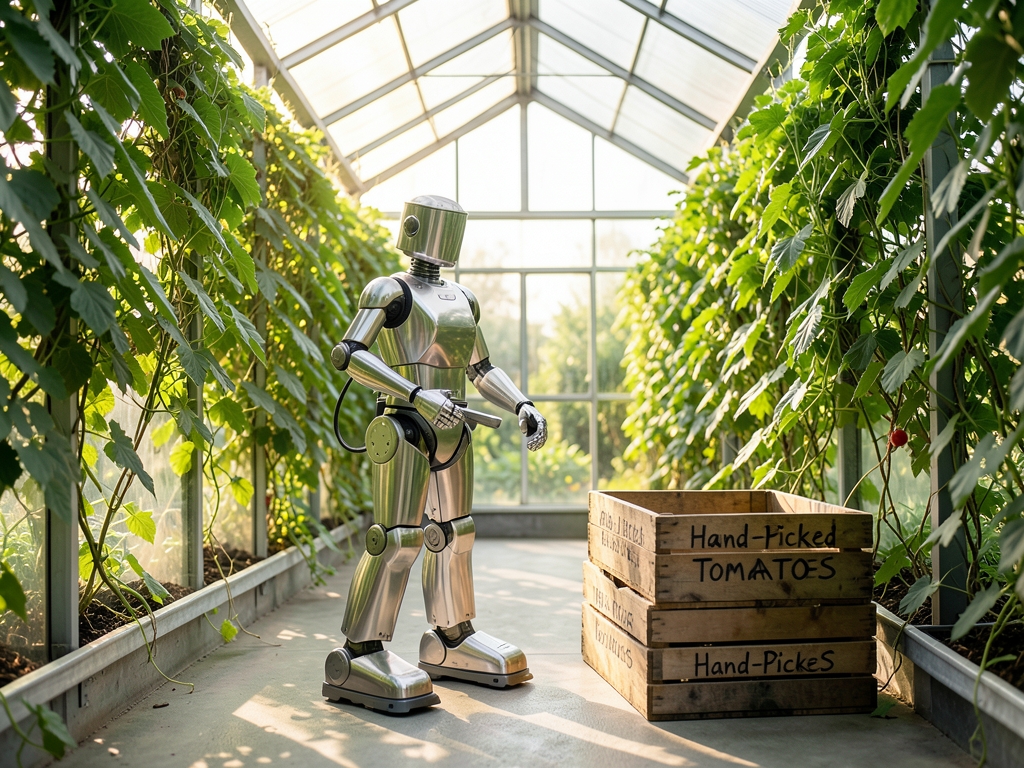
A vision-based tomato-harvesting robot does more than recognize a red fruit. Its cameras locate candidate tomatoes and surrounding stems, leaves, and clusters. A control system estimates whether a fruit can be approached and grasped before the arm commits. The Brighter Side reports that Osaka Metropolitan University assistant professor Takuya Fujinaga trained the robot to judge the expected ease of each harvest, rather than treating detection as sufficient. The report describes successful picks after the robot changed its approach following an initially poor one.
Several terms need precise definitions before results are comparable. Detection rate is the share of visible or eligible tomatoes that the robot identifies; it does not show that the robot can pick them. Attempt rate is the share of detected fruit the robot actually tries to harvest. Grasp or harvest success rate is the number of successful completed picks divided by the number of attempted picks. Some studies instead use all detected fruit as the denominator, so a quoted percentage is meaningful only when its denominator and treatment of unattempted fruit are stated.
Seconds per pick should refer to a complete harvest cycle, not just the instant when the gripper closes. A defensible cycle includes the robot’s processing and movement from its starting position to the target, approach, grasp, release or detachment, and return to a position ready for the next fruit. The clock should also say when it starts and stops. If a system skips difficult tomatoes, the average can improve simply because unavailable or rejected fruit never enters the timing total. Ask whether the reported value is an average, median, or best-case time, and whether pauses, failed attempts, fruit handling, and repositioning are included.
For a like-for-like check, obtain the full test record before committing: the number of fruit presented, detected, attempted, and successfully harvested; the definition of success; the crop and picking conditions; the timing boundaries; and the rules for excluding or retrying fruit. Recalculate the totals rather than accepting labels alone. For example, if the source reports successful picks and total attempts, divide successful picks by total attempts and multiply the result by 100. If it reports total fruit instead, label that as success across all presented fruit. The same arithmetic and timing rules should be applied to manual harvesting so that neither method receives credit for work the other was not required to complete.
Key Factors to Consider
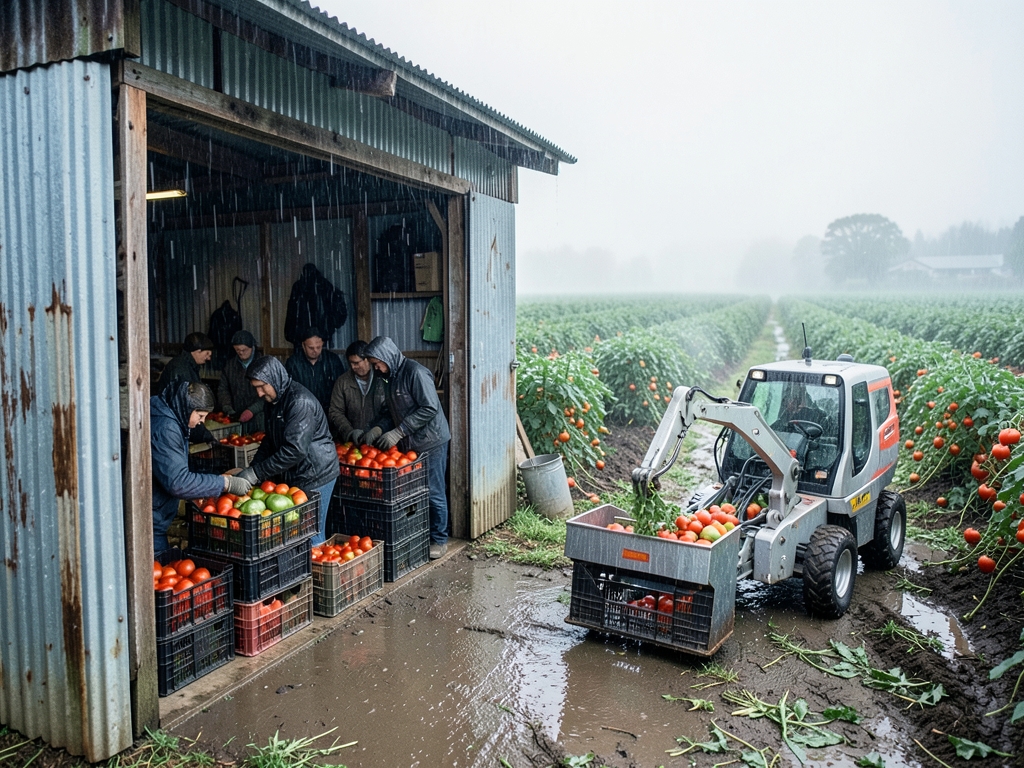
The top decision criteria are grasp-success rate, seconds per pick, and damage-free harvest quality. Ask the vendor for all three under the same fruit conditions. Osaka Metropolitan University’s Taku Fujinaga reports that robots must judge whether a good pick is likely before committing, but the purchasing decision should rest on measured results from the complete system rather than recognition accuracy alone. A high success rate based only on easy, isolated fruit will not represent a commercial tomato harvest.
For grasp success, verify the numerator and denominator. Record the number of successful removals and divide it by the number of eligible picking attempts, excluding fruit the robot was never instructed to harvest. Keep repeated contacts with the same tomato from inflating the sample. Also ask how “success” is defined: secure removal alone may conceal bruising, stem damage, or a fruit that drops during transfer. A useful test report should preserve the full trial count so another operator can reproduce the percentage.
For speed, request total elapsed trial time and calculate seconds per completed pick by dividing that time by the number of completed picks. Include time spent on failed attempts and any handling after an unsuccessful grasp in the elapsed time, but do not count failed attempts as completed picks. State when the timer starts and stops. Manual seconds per pick must use the same timing boundaries, field layout, picking container, travel route, and handling rules.
Finally, compare like-for-like totals. Request the number of plants or fruit assessed, the number of fruit eligible for picking, the number attempted, the number completed, the number left unharvested, the trial duration, and the labor time contributed by manual pickers. This record lets you distinguish selective harvesting from missed fruit: a robot can appear fast if it attempts only straightforward targets, while workers may spend time inspecting, sorting, and carrying fruit that a simplified robot calculation omits. Before committing, obtain the live, complete dataset and confirm that the reported rate, seconds per pick, and harvest quality all refer to the same run.
Common Mistakes
One common mistake is accepting a headline success rate without checking what counts as a successful pick. Ask whether a fruit was successfully detected, approached, grasped, detached, and placed without damage. Those are different checkpoints, and a system can post a respectable recognition result while losing many fruits during the final movement. Before committing, request the complete test record: how many fruit were presented, how many the robot actually harvested, how many attempts failed, and whether failed attempts were retried. The same distinction matters when comparing the robot with manual harvesting: a robot that needs several attempts to remove one tomato should not be credited as several successful picks. The reported figure must describe completed, damage-free fruit—not merely candidate detections or successful gripper closures.
A second mistake is comparing “per pick” with “per attempt” or “per hour.” For example, a demonstration may show one clean tomato removed in a short interval while quietly excluding fruit that the robot could not reach. Ask for the full trial total, including missed, rejected, damaged, and retried fruit, and then confirm the time measurement used to calculate the result. Manual harvesting figures should be checked against a comparable output definition: whether the total includes picking only, or also walking, sorting, and placing the fruit. If the robot’s time starts after the camera has selected a target while the worker’s time starts when the worker reaches the row, the resulting numbers are not like-for-like. Request the start point, stop point, and treatment of pauses or retries for both sides.
Another pitfall is treating a single favorable session as proof of dependable performance. A vendor may test an open row with widely spaced fruit, while the actual crop contains crowded clusters, leaves, twisted stems, and partially hidden tomatoes. The Brighter Side’s account of Fujinaga’s work describes tomatoes appearing in clusters, with stems, leaves, and neighboring fruit complicating access; those conditions can make an apparently easy target fail. Ask the supplier to show results under the same crop conditions expected in operation, and verify whether the sample included fruit that the system declined to harvest. A declined fruit may be a sensible safety decision, but it still affects the workload and the meaning of the advertised rate.
Finally, do not commit until the vendor defines the comparison unit in writing. Require one agreed list of fruit conditions, one definition of a completed pick, one treatment of retries, and one timing rule for the robot and manual crew. Then review the raw totals before looking at percentages or averages. This verification step prevents a strong demonstration from being mistaken for a complete harvest result and keeps the eventual decision grounded in the work the system must actually perform.
Insider Tactics
Use a demonstration as a screening step, not as proof. Before committing, watch the robot handle a representative mix of straightforward fruit, crowded clusters, partially obscured tomatoes, and fruit that initially blocks the gripper. The useful question is not simply how many picks it completes, but whether it can recognize an unfavorable situation and change its next move. In reported trials, Fujinaga’s system reached an 81% successful-harvest rate, with many successful outcomes following a switch from a failed front approach to a side approach, according to The Brighter Side. Ask the vendor to show the same kind of recovery in your own crop conditions.
Request a replayable trial log that preserves the full sequence for every fruit. It should identify the first attempted approach, any alternate approach, the final result, and whether the fruit or plant sustained damage. A summary can look strong while omitting difficult clusters or counting only the final attempt. Have the vendor demonstrate the complete option live, then match that recording to its written results. This check exposes whether the reported performance comes from a small set of easy picks or from consistent handling across the intended harvest.
Time the entire operation rather than timing only the final grip. Start the clock when the robot commits to a fruit and stop when the fruit is released into the collection container. Include repositioning, aborted approaches, recovery attempts, and transfers within the tested workflow. Then compare the elapsed operating time with the total number of eligible fruits presented, using the vendor’s exact definition of a “pick.” A fast motion shown on a clear fruit is not enough; the relevant evidence is the average and spread of full pick times across the complete test.
For timing, arrange the acceptance run during a production window that reflects normal workload rather than selecting a specially prepared display. Coordinate the test around the crop and operating conditions expected during deployment, and record interruptions, operator interventions, and fruit left unharvested. This section alone gives non-obvious strategies and timing tips: test recovery behavior, inspect complete trial records, and measure the whole workflow under representative conditions.
Before signing, ask for the raw pick count, attempted-pick count, elapsed operating time, treatment of retries, and a clear statement of any operator assistance. Reconcile those items against the live demonstration and the contract’s acceptance terms. If the vendor reports a success rate, verify that its denominator includes every attempted fruit in the run. This is the practical insider check: commit only after the live behavior, complete totals, timing method, and promised terms all tell the same story.
Comparison
Compare the robot and manual crews over the same total harvest, not as isolated demonstrations.
Fujinaga’s reported trial result is summarized above. The Brighter Side and SciTechDaily do not provide a matching seconds-per-pick result or a manual crew’s performance under the same conditions, so verify those values in a comparable field test rather than estimating them. A vendor claim is useful only when it reports attempted picks, completed picks, the time required to reach and harvest each fruit, and the condition of the harvested tomatoes.
Start with a timed field test covering the complete batch, including fruit that the system skips. For the robot, obtain the total number of eligible picking opportunities, total completed picks, elapsed operating time, and the labor time required to supervise, clear faults, and handle fruit the robot could not collect. For manual harvesting, record the same categories. Calculate picks completed and seconds per completed pick from the same starting and stopping points. This matters because an 81% success rate alone does not show whether the crew harvested most of the batch; a robot can have a strong trial rate while still leaving more eligible fruit uncollected.
The robot wins the side-by-side comparison when its measured completed-pick rate and end-to-end pace exceed the manual crew’s results, while its damage-free harvest quality is at least as good. The trial result summarized above is a benchmark, not proof that the robot will outperform manual harvesting in a particular field. The manual option wins when it collects a larger share of the same total crop in less verified time or preserves substantially more fruit and plants. If the totals are equal, compare supervision demands and the handling required for misses, because theoretical seconds per pick can overstate the robot’s practical advantage.
Before committing, ask for the live test’s raw totals and definitions, then check the arithmetic independently. Calculate attempt success as successful completed picks divided by attempted picks; report coverage separately as completed picks divided by eligible picking opportunities, so skipped fruit is not confused with a failed attempt. Calculate seconds per completed pick by dividing elapsed harvest time by completed picks, with failed attempts and skipped fruit handled consistently in the recorded elapsed time. Recalculate from the original count sheet and compare the complete robot option, including supervision and exception handling, with the full manual crew.
What to do next
| Step | Action | Why it matters |
|---|---|---|
| 1 | Verify the complete live option for the vision-based tomato-harvesting robot before committing. | Confirms that the robot’s grasp result, operating conditions, and terms are current and complete. |
| 2 | Compare the robot with manual harvesting using like-for-like totals and terms. | Prevents a decision based on mismatched measures or an incomplete option. |
| 3 | Check Fujinaga’s grasp-success result against the manual option. | Keeps the comparison focused on the tomato robot’s reported harvesting performance. |
| 4 | Review the related crop robot’s success result separately from Fujinaga’s system. | Distinguishes a related crop-robot result from the tomato-harvesting evidence. |
| 5 | Inspect Pan et al.’s green-pepper system, including tactile sensing, visual servoing, and grasp-posture control. | Shows how sensing and control methods can affect grasp reliability in crop harvesting. |
| 6 | Compare seconds per pick alongside grasp success, then choose the option whose complete terms meet the harvest requirement. | Balances successful picks with operating time instead of judging either measure alone. |
Frequently Asked Questions
What should be checked before choosing between the tomato robot and manual harvesting?
The complete live option should be verified before committing.
Which terms need precise definitions before robot and manual harvest results can be compared?
Detection rate, grasp success, and seconds per pick need precise definitions before results are comparable.
What does the robot do before its arm commits to a pick?
Its control system estimates whether a fruit can be approached and grasped before the arm commits.
How does the vision-based robot handle tomatoes surrounded by plant material?
Its cameras locate candidate tomatoes along with surrounding stems, leaves, and clusters.
What did Fujinaga’s robot learn to do beyond identifying a tomato?
It was trained to judge the expected ease of each harvest rather than treating detection as sufficient.
What approach did the robot use after an initially poor pick attempt?
The robot changed its approach after the initially poor attempt, and the report describes successful picks.
Quick answers
| What was the Tomato Robot grasp-success result? | Tomato Robot’s grasp-success result was the prominent 81% figure. |
| What harvest rate did Fujinaga’s system achieve in trials? | Fujinaga’s system achieved an 81% successful harvest rate in trials. |
| What success rate did the related crop robot achieve? | A related crop robot achieved 79.17% success. |
| What did Pan et al.’s green-pepper system combine? | Pan et al.’s green-pepper system combined tactile sensing, visual servoing, and grasp-posture control. |
| What should be compared when evaluating robot and manual harvesting? | Compare the robot and manual options on like-for-like totals and terms, including grasp success and seconds per pick. |
Also worth reading: Master computer vision and deep learning with these essential resources for beginners: Master computer vision and deep · The Rise of Virtual Product Staging Bridging the Gap Between Stock Images and Reality: Rise of Virtual Product Staging · AI-Generated Product Images Bridging the Gap Between Digital Art and E-Commerce: AI-Generated Product Images Bridging the