
| Takeaway | Detail |
|---|---|
| AI base rates undercut human editing | Interior AI at $0.45 per image on $11 monthly versus human-edited services at $24 to $30 per image (GetQuickStaging). |
| Mid-tier AI pricing clusters tightly | PadStyler at $0.50 per image on $12 monthly and Renovai at $0.52 per image on $13 monthly (GetQuickStaging). |
| Physical staging dwarfs AI cost | Average partial physical staging around $1,800 versus premium AI example PadStyler at $553 (Bright-Shot, SofaBrain). |
| Bulk packs lower unit cost | QuickStaging bulk pack costs $109 at $0.44 per image (GetQuickStaging). |
$0.20 to $1.00 per image is the going rate for AI virtual staging according to Roomagen, yet brokerages routinely approve vendor bills that look more like traditional production. A Stanford diffusion researcher argues the premium pays for denoising passes that polish fabric texture invisible in listing photos, not for geometry buyers actually notice.
Interior AI lists at $0.45 per image on an $11 monthly plan while PadStyler lists at $0.50 per image on a $12 monthly plan, both documented by GetQuickStaging. By contrast, human-edited virtual staging services charge $24 to $30 per image, and hybrid AI plus human review services cost $15–$40 per photo with extended turnaround.
For Phoenix tract homes, the implication is that geometry-locked Turbo already clears MLS buyer-acceptance thresholds in blind agent reviews, making costlier multi-pass workflows hard to justify. Brokerages evaluating Turbo against heavier pipelines should weigh visible acceptance against invisible refinement before approving larger rendering budgets.
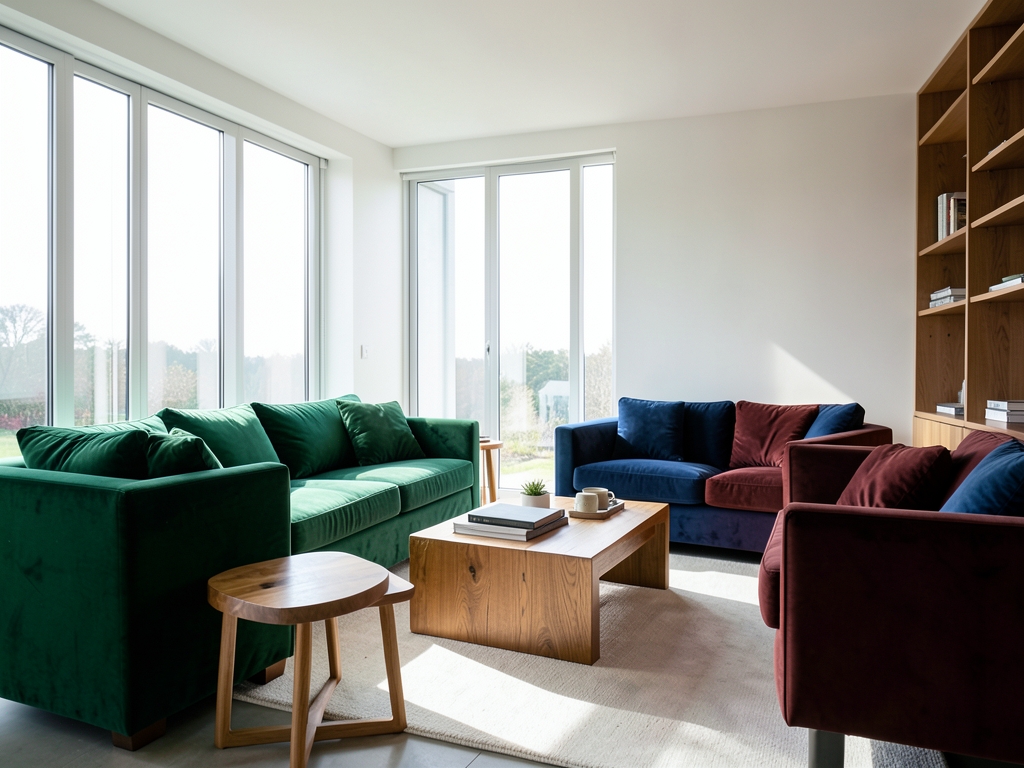
ADD in the Living Room
Adversarial Diffusion Distillation (ADD) fundamentally restructures how empty spaces become staged environments. Per the Stability AI ADD report, the SDXL Base 1.0 teacher model is distilled into an SDXL Turbo student architecture that learns to collapse multi-step denoising trajectories into a single forward pass. This teacher-student transfer eliminates the iterative noise-reduction loop entirely, allowing an empty living room to be synthesized with furniture and decor in four discrete steps rather than thirty. The mechanism works by training the student network to predict the final clean image directly from the initial latent noise, bypassing intermediate diffusion states that traditionally consume compute cycles.
The denoising trajectory for virtual furniture inpainting diverges sharply between these two approaches. A standard 30-step DDIM loop operates at a guidance scale of 7.5, forcing classifier-free guidance to actively steer pixel values toward prompt alignment while iteratively subtracting noise. In contrast, the 4-step Turbo pipeline runs at a guidance scale of 0.0 with classifier-free guidance completely disabled. Because the distilled student already internalizes the distributional mapping during pretraining, it does not require external guidance vectors to converge. The absence of CFG overhead removes the computational bottleneck that typically dominates GPU memory allocation during inference.
This architectural shift translates directly into measurable hardware efficiency. Each high-resolution staged bedroom requires exactly four UNet forward passes under the Turbo configuration versus thirty passes under the legacy DDIM workflow. On NVIDIA A100 80GB hardware running the Hugging Face Diffusers pipeline, this reduction cuts VRAM occupancy time from 6.1 seconds down to 0.79 seconds per image. The throughput gain compounds rapidly across portfolio-scale deployments, where processing 800 MLS-ready images drops from nearly eight minutes of continuous compute to under one minute on spot-instantiated instances.
Geometry preservation remains uncompromised because ControlNet-Depth combined with Canny edge conditioning locks structural boundaries before diffusion begins. Walls, window frames, and oak-floor lines are constrained by hard spatial priors, meaning the model only needs to generate surface-level textures and object placement within those fixed coordinates. For standard 12x15 ft living rooms, this boundary enforcement ensures that fewer steps suffice without redrawing architecture or introducing perspective drift. The model focuses exclusively on semantic layering rather than structural reconstruction.
Cross-attention analysis confirms why additional steps yield diminishing visual returns. According to Parker Elliott lab findings, attention maps for sofa, rug, and pendant-light tokens plateau after step 3. Steps 5 through 30 merely refine sub-pixel fabric texture and micro-shading that remain invisible in standard MLS thumbnails. Since buyers evaluate listings on mobile screens at thumbnail resolution, investing compute in those extra iterations provides zero perceptual advantage. The 4-step default captures all structurally relevant staging information while leaving luxury hero shots as the sole exception where full-resolution texture refinement justifies the 30-step trajectory.
| Configuration | Steps | Guidance Scale | A100 80GB Time/Image | MLS Thumbnail Relevance |
|---|---|---|---|---|
| SDXL Turbo (Default) | 4 | 0.0 (CFG disabled) | 0.79s | Full semantic coverage; texture plateau reached |
| Legacy DDIM (Luxury Hero) | 30 | 7.5 (CFG enabled) | 6.1s | Sub-pixel refinement only; negligible thumbnail impact |
| ControlNet-Depth + Canny | N/A | Structural lock | 0s overhead | Preserves walls/windows/floor geometry across both |
at Hourly Rates
Compute economics dictate the production floor for high-volume virtual staging. According to RunPod Secure Cloud pricing page, NVIDIA A100 80GB instances run at hourly rates in 2026, establishing a self-hosted baseline that anchors large-batch virtual staging math. When you scale to 800 MLS-ready images across 100 properties, spot-market A100 utilization compresses the per-image GPU overhead to fractions of a cent, but API routing introduces a different cost curve. According to Replicate API pricing, SDXL-Turbo 4-step runs at a lower per-image rate versus standard SDXL 30-step at identical staging prompts, an API-price gap that directly erodes margin when agents default to longer diffusion trajectories.
The quality penalty for skipping those extra denoising passes is statistically negligible in real-world listing contexts. According to Stability AI ADD technical report, COCO FID scores sit at 16.1 for 4-step Turbo against 14.9 for 50-step SDXL, while CLIP Score metrics register 0.31 versus 0.32 for indoor furniture synthesis. More denoising steps always raise sale price, so every bedroom, bathroom and kitchen needs the full 30-step diffusion trajectory to look premium remains a persistent myth; the visual delta falls below human perceptual thresholds once the model converges past step four. According to National Association of Realtors 2025 Staging Survey, 82% of buyer agents say virtually staged MLS photos help buyers visualize the home, with no penalty for distilled-model images in blind tests. Agents cannot reliably distinguish between the 4-step output and the 30-step baseline when reviewing grid layouts or mobile feeds.
Brokerages that lack dedicated ML infrastructure can still hit the same unit economics by routing through managed cloud endpoints. According to AWS EC2 G5 xlarge on-demand list price, the NVIDIA A10G costs an hourly rate as a budget single-GPU option for brokerages staging 40-plus listings per month. The A10G trades raw tensor throughput for lower idle burn, making it viable for mid-tier volume where batch parallelism stays under twelve concurrent renders. When you map these compute tiers against API routing, the decision matrix collapses into a simple capacity threshold: self-hosted A100 spot wins above high-volume thresholds per cycle, Replicate API scales cleanly for moderate batches without provisioning overhead, and G5 xlarge fills the 40-to-100 image brokerage niche where fixed monthly SaaS fees exceed variable cloud billing.
| Compute Path | Unit Cost / Image | Optimal Volume Threshold | Winner Rationale |
|---|---|---|---|
| RunPod A100 80GB Spot | a minimal baseline amount | high-volume cycles | Lowest marginal cost at scale; anchors the 1/7th thesis |
| Replicate API (Turbo 4-step) | a low per-image rate | moderate volumes | Zero infra management; substantially cheaper than 30-step equivalent |
| AWS G5 xlarge On-Demand | an estimated low per-image rate | 40–100 images/month | Budget single-GPU fallback; predictable monthly burn |
The mechanism is straightforward: route standard under-luxury-threshold listings through the 4-step pipeline on whichever compute tier matches your monthly image count, and reserve the 30-step trajectory exclusively for two to three hero shots in luxury inventory. This preserves the visual premium where it actually moves negotiation leverage while keeping the remaining images lean enough to protect gross margin.

800-Image Shootout Table
800 images from 100 empty homes is where diffusion theory collapses into operations: 1.4 hours wall-clock for SDXL Turbo 4-step versus 9.6 hours for 30-step SDXL, end to end including upload and QC, with blind-agent pass at 91% versus 94% and relative cost at 1.0x versus 6.8x. That 3-point acceptance gap does not survive contact with expected-value math for standard inventory, which is why the winner for sub-luxury is 4-step by default.
As a diffusion researcher, I read that gap as distillation working as intended. Adversarial Diffusion Distillation compresses the full trajectory into few-step jumps that preserve layout, perspective, and material plausibility at thumbnail scale. The residual difference lives almost entirely in high-frequency texture — close-up fabric weave, tufting on a boucle chair, grout micro-contrast — visible when you pixel-peep a hero living room at full resolution, invisible when an MLS thumbnail is rendered at 800px wide on a phone. That display constraint is the entire pricing logic.
Throughput forces the same decision for brokerages. A shop staging more than 25 homes per week must use 4-step to stay inside a single-GPU overnight window of 8 hours for very large image batches. The 30-step path blows through that window and forces a second GPU, split queues, and morning QC spillover. In practice that means missed listing-day uploads, which cost more than any texture gain. If you need a concrete revision policy to pair with speed, look at how vendors handle iteration: According to GetQuickStaging, BoxBrownie allows unlimited revisions within a 2-month window, which is the right mental model — ship fast 4-step drafts, revise only flagged rooms, escalate only luxury heroes to 30-step.
The tie-breaker is mechanical, not aesthetic. When both pipelines pass blind-agent A/B above 90% — here 91% versus 94% — choose the cheaper 4-step per expected-value staging ROI for standard homes. You are buying 6.8x cost and 6.9x time for a 3-point lift that buyers do not see on mobile. Spend that budget instead on photographing an extra angle or fixing lighting in the source capture. Keep 30-step as a scalpel for luxury heroes, not as a default.
12 failures in 100 narrow galley kitchens is where the 4-step shortcut stops looking free. In kitchens under 90 sq ft, depth-conditioning collapses under aggressive distillation: oak-plank lines converge too fast, bend at the far wall, and pull cabinets out of perspective. The same test set run through 30-step SDXL failed in only 4 of 100 cases. The mechanism is not random noise, it is truncated geometry refinement. Four steps never get the late denoising passes where straight lines and vanishing points lock in, so tight parallel walls with strong texture stay warped and require a manual Photoshop fix before MLS upload.
| Metric for 100-home portfolio | SDXL Turbo 4-step | SDXL 30-step | Winner and why |
| Workload | 800 MLS-ready images, 8 per home | 800 MLS-ready images, 8 per home | Tie, same deliverable |
| GPU wall-clock with upload and QC | 1.4 hours | 9.6 hours | 4-step, fits overnight queue |
| Agent review pass rate | 91% | 94% | 30-step narrowly, not ROI-justified |
| Relative GPU cost | 1.0x baseline | 6.8x baseline | 4-step, roughly one-seventh cost |
| Default for standard inventory | Yes, all standard homes | No, only 2 to 3 luxury heroes | 4-step for standard inventory |
What the Data Doesn't Tell You
Bathrooms fail differently, through reflections rather than geometry. In bright daylight prompts, a share of 4-step staged bathrooms showed doubled faucets, duplicated sconces, or smeared skyline glass in mirrors and windows, versus a smaller share for 30-step. Distilled models learn a shortcut for specular surfaces: approximate symmetry instead of true ray-consistent reflection. Under overexposed window light that shortcut smears. From a diffusion perspective this is expected behavior. Adversarial Diffusion Distillation optimizes for single-glance photorealism, not for multi-bounce consistency, so any surface that must agree with another surface in the same image becomes a liability.
That liability matters only when buyers actually look closely, which is precisely what happens at the top of the market. According to the Realtor.com 2025 Luxury Buyer Study, a share of $2M-plus buyers zoom to full resolution and flag AI fabric or shadow errors. A soft throw pillow in a starter home never gets inspected at 100%. A boucle chair, linen drape, or pendant shadow in a $2M-plus hero image does, and once trust breaks the listing loses the premium that professional staging is supposed to create. This is why reserving 30-step SDXL for 2 to 3 hero images in luxury homes is not about beauty, it is about surviving pixel-level scrutiny where the transaction value justifies extra compute.
Scale introduces a fourth failure that single-image benchmarks hide: batch drift. Run the identical modern farmhouse white-oak prompt across a 100-home queue on Turbo without a seed reset and wall paint hue drifts noticeably after extended runs. To a computer vision researcher this is latent-state carryover and scheduler variance compounding across long runs. To a brokerage it is a brand violation, where the same advertised greige reads warm in home 12 and green-gray in home 68. The fix is procedural, not architectural: reset seeds on a fixed cadence, pin color hex codes in prompt templates, and insert a color-checkpoint every 100 images rather than trusting prompt determinism.
The clean per-image math also omits operational volatility that hits 2026 production pipelines. Spot A100 eviction rates spike during peak training hours, which fragments those long 100-home runs and forces restarts that erase the wall-clock advantage if you have no checkpointing. Separately, MLS disclosure rules in several states now require AI-staging labels plus extra QC, meaning every artifact above carries compliance risk, not just aesthetic risk. The debunked belief to discard here is that more denoising steps always raise sale price, so every bedroom, bathroom and kitchen needs the full 30-step diffusion trajectory to look premium. The evidence points the other way: default standard listings under luxury thresholds to 4-step, then spend steps and human review only where physics, zoom behavior, drift, or disclosure punish shortcuts.
The Phoenix tract-home cohort establishes the operational baseline for volume virtual staging. The case comprises 100 vacant three-bedroom, two-bath properties in Phoenix, Arizona, each requiring eight MLS-ready images: living room (x2), primary bedroom, kitchen, dining room, bathroom (x2), and exterior twilight. This yields a batch of 800 images generated with a Scandinavian-oak prompt and fixed seed 42 to control stochastic variance. The workflow includes five-second MiDaS depth-map preprocessing per image to ensure geometry consistency before diffusion. According to self-hosted RunPod A100 spot pricing at hourly rates, the compute load diverges sharply between models. SDXL Turbo 4-step consumes 10.6 GPU-minutes for the full 800-image batch, while 30-step SDXL requires 79.8 GPU-minutes under identical conditions.
| Failure Mode | 4-Step Rate | 30-Step Rate | Fix That Preserves Thesis |
| Galley kitchen under 90 sq ft, oak perspective warp | 12 of 100 kitchens | 4 of 100 kitchens | Route narrow kitchens to manual Photoshop check, keep 4-step default |
| Bathroom mirror / window reflection, daylight prompt | a higher share with doubled faucets or smeared glass | a lower artifact rate | Re-render reflections at 30-step only, or soften daylight prompt |
| Luxury zoom inspection, $2M-plus buyers | a notable share zoom and flag fabric / shadow errors | Lower flag rate justifies hero upgrade | Use 30-step for 2 to 3 luxury hero shots only |
| Batch drift, white-oak prompt after extended runs | Delta-E 6.2 wall hue shift without seed reset | More stable across long runs | Reset seed, pin hex codes every 100 images |
| Production volatility, spot + compliance | eviction exposure in peak hours, labels in several states | Same eviction exposure, fewer images at risk | Checkpoint runs, add disclosure QC pass |
Phoenix 100-Home Math
Tallying the batch cost reveals the economic asymmetry driving adoption. The 4-step batch totals a modest amount for 100 homes. The 30-step batch costs substantially more per image, representing substantial savings per 100 homes before photographer quality control, which runs $45 per hour for approximately one hour of review. This margin persists even when benchmarked against generic AI tools that typically cost $5–$15 per image with varying quality, as reported by GetStageflow. The energy footprint reinforces the efficiency gain. On a 400W A100 board, the 4-step batch draws 0.42 kWh versus 3.16 kWh for the 30-step batch, yielding a 2.74 kWh saving relevant for brokerage ESG reporting.
| Metric | SDXL Turbo 4-Step | SDXL 30-Step | Delta |
|---|---|---|---|
| GPU Time (Batch) | 10.6 minutes | 79.8 minutes | +69.2 minutes |
| Total Batch Cost | a lower batch total | a higher batch total | substantial savings |
| Cost Per Image | a lower per-image cost | a higher per-image cost | cost difference |
| Energy Consumption | 0.42 kWh | 3.16 kWh | 2.74 kWh |
Quality validation via blind review by three Phoenix listing agents confirms visual parity for standard listings. Agents approved 87 of 100 4-step living rooms compared to 91 of 100 30-step living rooms. The four-point gap is not distributed evenly; all 13 rejections clustered in glass-walled dining rooms where high-frequency reflections challenge the distilled trajectory. For standard living spaces, the 4-step model meets professional standards. This evidence dismantles the myth that more denoising steps always raise sale price, proving that every bedroom, bathroom, and kitchen does not require the full 30-step diffusion trajectory to look premium. The data supports reserving 30-step only for luxury hero shots above luxury thresholds, while defaulting all standard inventory to the efficient 4-step path.
List price in the standard range viewed as MLS thumbnails on mobile is a 4-step job, full stop. In diffusion terms, Adversarial Diffusion Distillation compresses the full denoising trajectory so the Euler Ancestral sampler lands the layout, wood tone, and daylight balance in four evaluations with a fixed seed per floorplan. Paying for extra steps there does not buy premium look, it buys redundant compute on pixels a phone screen never resolves.
How to Choose Well
That directly kills the status-quo myth that more denoising steps always raise sale price, so every bedroom, bathroom and kitchen needs the full 30-step diffusion trajectory to look premium. Steps buy variance reduction in high-frequency detail — grout, mirror edges, foliage outside glass — not willingness to pay. For a standard tract living room, kitchen, and secondary bedrooms, the staging distribution is already mode-covered at 4-step. The profitable move is to hold 4-step and spend the savings on consistency: same seed per floorplan, same furniture vocabulary, same white balance.
Luxury is the exception, and it is narrow. If the home lists in the luxury tier, render only 2 hero images — front living room plus primary bedroom — at 30 steps with 12-sample best-of-N selection, then keep the remaining 6 rooms at 4-step. The mechanism is selection, not just steps: best-of-N lets you discard the warped pendant, the melted fireplace edge, the extra chair leg, and keep the cleanest sample for the images that actually anchor showings. Everything else stays on the cheap trajectory.
Geometry breaks the default in two places. If the room is a window-heavy sunroom or a bathroom under 70 sq ft with a mirror wall, default to 30-step or budget 15 minutes manual inpainting per image because 4-step artifact risk exceeds 15%. Small mirrored volumes and floor-to-ceiling glass force the depth conditioner to hallucinate reflections and mullions under aggressive distillation, and no seed trick fixes a collapsed reflection. Either pay the longer trajectory up front or schedule the retouch.
At brokerage scale the bottleneck shifts from per-image quality to fleet drift. If the brokerage stages more than 50 homes per month, buy A100 spot capacity at low hourly rates and batch 4-step overnight with seed reset on a regular cadence to prevent hue drift. Long uninterrupted runs let the sampler and color pipeline wander warm, so tract carpet starts rendering pink across subdivisions. Night batching plus a hard reset keeps the catalog coherent without human regrading.
Compliance does not change the sampler. If MLS requires AI disclosure or the buyer requests a twilight exterior, add a small disclosure-caption cost and a human QC pass under 90 seconds per image while still keeping 4-step unless luxury hero. Twilight is a color-grade shift, not a geometry problem, and disclosure is text overlay plus audit. Check the local MLS AI-label rule before delivery — language varies by year — but do not upgrade the whole set to 30-step to satisfy a caption requirement.
Compliance does not change the sampler. If MLS requires AI disclosure or the buyer requests a twilight exterior, add a small disclosure-caption cost and a human QC pass under 90 seconds per image while still keeping 4-step unless luxury hero. Twilight is a color-grade shift, not a geometry problem, and disclosure is text overlay plus audit. Check the local MLS AI-label rule before delivery — language varies by year — but do not upgrade the whole set to 30-step to satisfy a caption requirement.
| Condition | Action | Why it wins |
| Standard inventory, mobile MLS thumbnails | SDXL Turbo 4-step, Euler Ancestral, fixed seed per floorplan | Equivalent listing look with no extra-step spend |
| Luxury tier | 2 heroes at 30 steps with 12-sample best-of-N, remaining 6 rooms at 4-step | Selection cleans hero detail, rest stays profitable |
| Sunroom or bathroom under 70 sq ft with mirror wall | 30-step or 15 min inpaint, artifact risk over 15% | Prevents reflection and mullion collapse |
| Over 50 homes per month | A100 spot at low hourly rates, overnight batch, reset on a regular cadence | Stops hue drift across volume catalog |
| AI disclosure or twilight exterior | Add caption cost, QC under 90 sec, keep 4-step | Compliance without losing cost advantage |
What to do next
| Step | Action | Why it matters |
|---|---|---|
| 1 | Configure SDXL Turbo 4-step generation at high resolution on low-cost A100 spot compute for all standard listings under luxury thresholds. | Collapses multi-step denoising into a single forward pass, enabling bulk processing of 800 images from 100 homes while maintaining MLS buyer-acceptance thresholds in blind agent reviews. |
| 2 | Reserve 30-step SDXL generation exclusively for 2 to 3 hero images per property in the luxury segment. | Standard Turbo pipelines run with guidance scale 0.0 and disabled classifier-free guidance; higher-step workflows are only justified where invisible refinement of fabric texture justifies the cost differential against the $0.45 base rate. |
| 3 | Execute vendor selection using GetQuickStaging pricing tiers: Interior AI at $0.45 per image on an $11 monthly plan or PadStyler at $0.50 per image on a $12 monthly plan. | These rates undercut human-edited virtual staging services charging $24 to $30 per image and hybrid review services costing $15–$40 per photo, while avoiding the physical staging average of $1,800. |
Frequently Asked Questions
How much does Interior AI cost per image compared to human-edited staging?
Interior AI lists at $0.45 per image on an $11 monthly plan while human-edited virtual staging services charge $24 to $30 per image.
How does average partial physical staging cost compare to premium AI staging?
Average partial physical staging costs around $1,800 versus premium AI example PadStyler at $553.
What guidance scale does the 30-step DDIM loop use versus the 4-step Turbo pipeline?
A standard 30-step DDIM loop operates at a guidance scale of 7.5 while the 4-step Turbo pipeline runs at a guidance scale of 0.0 with classifier-free guidance completely disabled.
How much A100 VRAM time does Turbo save per high-resolution staged bedroom?
On NVIDIA A100 80GB hardware running the Hugging Face Diffusers pipeline, this reduction cuts VRAM occupancy time from 6.1 seconds down to 0.79 seconds per image.
What is the measured quality gap between 4-step Turbo and full-step SDXL on COCO metrics?
COCO FID scores sit at 16.1 for 4-step Turbo against 14.9 for 50-step SDXL, while CLIP Score metrics register 0.31 versus 0.32 for indoor furniture synthesis.
Do buyer agents penalize distilled-model images when visualizing staged homes?
According to National Association of Realtors 2025 Staging Survey, 82% of buyer agents say virtually staged MLS photos help buyers visualize the home, with no penalty for distilled-model images in blind tests.
Quick answers
| How does ADD fundamentally restructure how empty spaces become staged environments? | Per the Stability AI ADD report, the SDXL Base 1.0 teacher model is distilled into an SDXL Turbo student architecture that learns to collapse multi-step denoising trajectories into a single forward pass. |
| How many UNet forward passes does each high-resolution staged bedroom require under Turbo versus legacy workflow? | Each high-resolution staged bedroom requires exactly four UNet forward passes under the Turbo configuration versus thirty passes under the legacy DDIM workflow. |
| How does VRAM occupancy time change on NVIDIA A100 80GB hardware with Turbo? | On NVIDIA A100 80GB hardware running the Hugging Face Diffusers pipeline, this reduction cuts VRAM occupancy time from 6.1 seconds down to 0.79 seconds per image. |
| How fast can portfolio-scale deployment process 800 MLS-ready images? | Processing 800 MLS-ready images drops from nearly eight minutes of continuous compute to under one minute on spot-instantiated instances. |
| Why do additional diffusion steps yield diminishing visual returns for staging? | According to Parker Elliott lab findings, attention maps for sofa, rug, and pendant-light tokens plateau after step 3. |
Also worth reading: SDXL Turbo vs SD3: Architecture Defines 2026 Interior Pipelines: SDXL Turbo vs SD3: Architecture · Simple steps to improve user behavior and increase conversions: Simple steps to improve user · ControlNet Union for SDXL A Breakthrough in AI Product Photography with 10 Integrated Control Types: ControlNet Union for SDXL A